

Vitamin C has built a reputation as the shortcut to bright, dewy, glowy skin, and it's everywhere right now. But it comes with a question a lot of people quietly ask: why isn't my vitamin C working? Often, the same chemistry that lets L-ascorbic acid neutralise sun damage is what makes it unstable, turning it rusty and orange. The result is an orange layer sitting on your skin doing nothing.
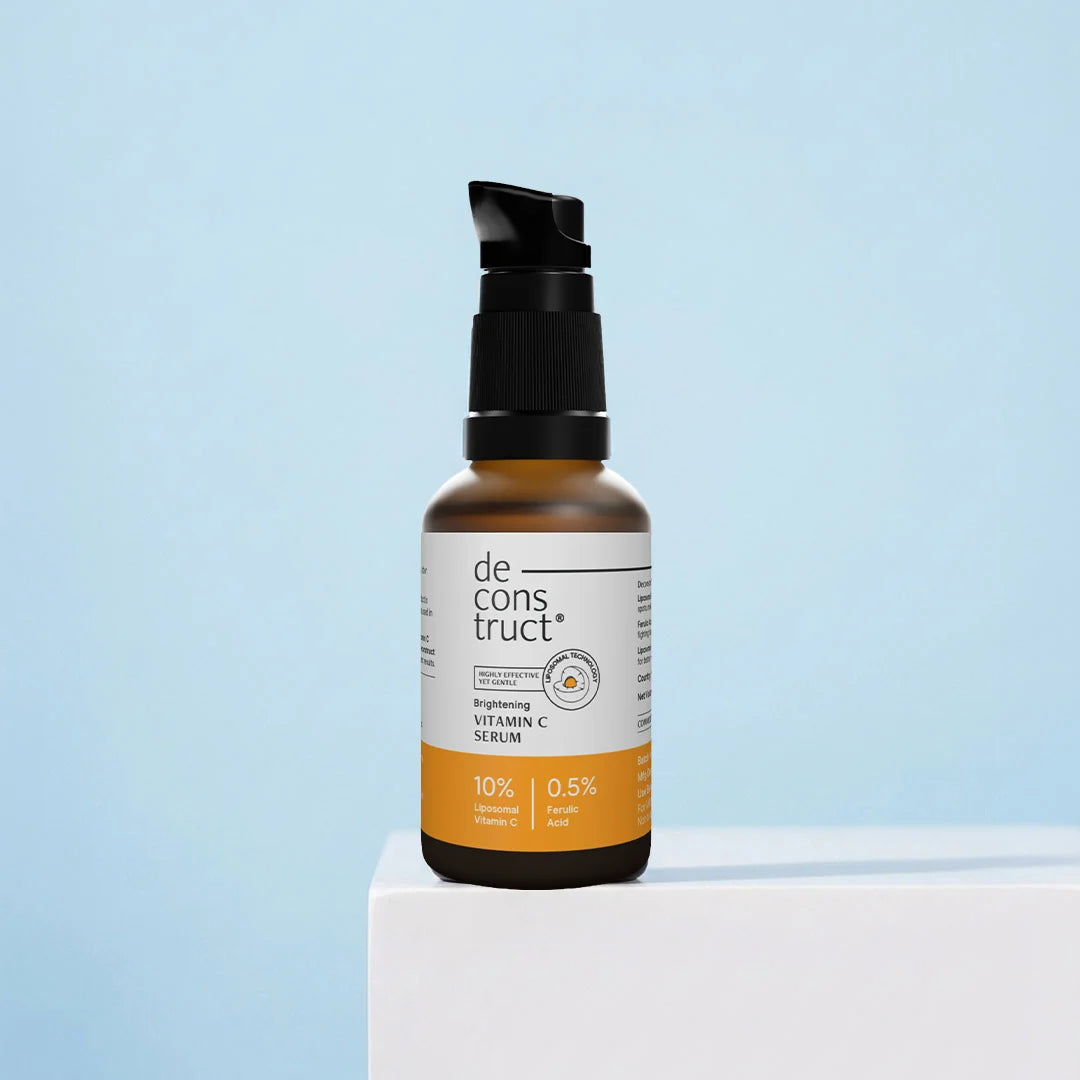
Deconstruct — Vitamin C + Ferulic Acid Serum
This guide breaks down the science of why your vitamin C serum, even a highly concentrated one, can still fail to deliver, and what to do about it.
The short version: most vitamin C "failures" come down to four fixable things — using it inconsistently, skipping sunscreen, an unstable formula, or judging results too early. A well-formulated, stabilised serum used daily for six to eight weeks almost always outperforms a stronger one used sporadically.
How Vitamin C Actually Works
What Vitamin C Does for Skin
Free radicals are unstable molecules triggered by UV, pollution, and even cigarette smoke. They break down collagen and drive premature ageing. Vitamin C works as an antioxidant blanket over your skin: it slows tyrosinase, the enzyme responsible for melanin production, which helps fade dark spots, sun spots, and hyperpigmentation, while also supporting collagen synthesis.1 If you want the deeper mechanism, here's a fuller look at how vitamin C improves skin glow.
Why Results Take Time
Vitamin C changes your skin at a cellular level, and new cells take time to form. That cycle, called skin cell turnover, runs roughly 28 to 40 days, which is why you won't see a clearer, more even tone until older, pigmented cells have shed and cycled out. As a rule, give any new active around 90 days before deciding it doesn't work for you.
5 Reasons Your Vitamin C Serum May Not Be Working
1. You're expecting results too quickly
We're wired for instant gratification, so it's hard to stick with one product when nothing shows in the first month. Most people quit before results are even due. Dermatologists suggest monitoring for 8 to 12 weeks before making the final call on an active. If your serum genuinely hasn't moved the needle after that, this guide on what to do when your vitamin C serum is not working is worth a read.
2. You're skipping sunscreen
Vitamin C and sunscreen work as a pair to defend against free radicals and UV. Without daily SPF, sun exposure keeps adding the very pigmentation your serum is trying to fade. Vitamin C is not a substitute for sunscreen: vitamin C builds the progress, SPF protects it. If you're still on the fence about this step, here's why sunscreen is genuinely mandatory in your routine.
3. The formula may not be stable
L-ascorbic acid, the most potent form of vitamin C, is notoriously unstable. It oxidises on exposure to air, light, and heat, turning yellow or orange and losing potency before it ever reaches your skin. Stabilising it is the whole game. Deconstruct's vitamin C serum uses liposomal delivery for better absorption and stability with less irritation, plus ferulic acid to keep the vitamin C from oxidising and turning orange. For more on why that pairing works, see vitamin C and ferulic acid: why the combo works and the benefits of liposomal serums.
4. You're using it inconsistently
Vitamin C rewards consistency because it works at a cellular level. Using it four days one week, skipping the next, then doubling up to compensate doesn't produce the same outcome as steady daily use. If you're unsure how to slot it in, here's how to use a vitamin C serum on your face.
5. Your skin concern requires multiple ingredients
Dark spots, post-acne marks, and deep pigmentation are multi-layered concerns. Vitamin C addresses one part — melanin inhibition and antioxidant protection. Pairing it with niacinamide, which blocks melanin transfer, or with SPF to prevent new pigmentation, builds a far more complete approach. One product rarely solves a complex concern. This comparison of vitamin C vs niacinamide for brightening and the roundup of the best vitamin C and niacinamide serums can help you layer smartly.
| Mistake | Potential impact |
|---|---|
| Inconsistent use | Slower, less visible results |
| Skipping sunscreen | Ongoing pigmentation despite treatment |
| Unrealistic expectations | Early product abandonment |
| Unstable formula | Reduced or zero effectiveness |
| Incomplete routine | Limited improvement on deeper concerns |
How Long Should Vitamin C Take to Show Results?
Surface dullness responds first — many people notice a subtle brightness within two to four weeks. Deeper concerns like post-acne marks, sun spots, and uneven tone take longer, usually 6 to 12 weeks of consistent daily use. The depth and age of the pigmentation directly affect how long it takes to fade.
Consistency matters more than speed
Chasing a higher concentration or switching products every few weeks almost always delays progress rather than speeding it up. A well-formulated serum used every day for eight weeks will reliably beat a stronger one used sporadically.
What to Look for in a Vitamin C Serum
Effective concentration
A concentration between 10% and 20% covers the range where vitamin C has been clinically shown to work. Below 10%, results are minimal. Above 20%, irritation risk climbs without a matching gain in results, which makes 10% a practical starting point for most skin types.
Stable formulation
Look for derivatives like 3-O-Ethyl Ascorbic Acid, which are more stable than pure L-ascorbic acid, or formulas that pair vitamin C with ferulic acid to stabilise it and extend its effectiveness. If you're weighing forms, this breakdown of L-ascorbic acid vs ethyl ascorbic acid and 3-O-ethyl ascorbic acid vs other vitamin C derivatives is useful.
Easy integration into daily routines
A lightweight, fast-absorbing texture layers comfortably under moisturizer and sunscreen, which reduces the friction that leads to skipped days.
Compatibility with sunscreen
Vitamin C applied in the morning pairs directly with SPF; the antioxidant protection it adds reinforces what sunscreen does, making the two more effective together than either alone.
Product Recommendation: Deconstruct 10% Vitamin C Serum
Why formulation matters
Even a cult-favourite ingredient underperforms if the formula is unstable or hard to use daily. The Deconstruct 10% Vitamin C Serum with Liposomal Technology is built around a stable vitamin C base, 3-O-Ethyl Ascorbic Acid, paired with ferulic acid to stabilise and strengthen it, while Cica and Panthenol keep skin calm and hydrated through the process.
Product deconstruction
10% Liposomal Vitamin C delivers the brightening and antioxidant benefits without the rapid oxidation that plagues L-ascorbic acid formulas, with liposomal delivery enabling slow, controlled release and deeper penetration.
0.5% Ferulic Acid stabilises the vitamin C, slows degradation, and boosts its photoprotective effect, so the formula works harder and lasts longer.
0.5% Centella Asiatica (Cica) Extract calms the skin and reduces redness, while 0.25% Panthenol hydrates and supports the skin barrier.
At 10%, it sits in the sweet spot: effective enough for visible brightening, gentle enough for beginners new to actives. The lightweight texture layers easily under moisturizer and SPF, removing one of the most common reasons people quit — a serum that feels heavy. It's also gender-neutral and clinically tested. If you're comparing options first, here's a guide to which vitamin C serum is best for the face in India and how it suits every skin type.
How to Get Better Results From Your Vitamin C Serum
Morning routine
Start with a gentle cleanser, apply the Deconstruct 10% Vitamin C Serum, follow with a lightweight moisturizer, and finish with a broad-spectrum SPF 50+. For a fuller plan that targets marks and tone, see how to build a complete anti-pigmentation routine.
Best practices
Apply every morning without skipping, because consistency is everything. Store the bottle away from direct sunlight and heat to preserve stability. Never skip sunscreen, since it protects the brightening progress your vitamin C is building. And commit to at least six to eight weeks before judging results. A slightly yellow tint in a vitamin C serum is normal and still safe to use; a deep orange means it has oxidised.
The Takeaway
Vitamin C earns its gold-standard reputation, but it works at a cellular level, so steady daily use over weeks is the rule, not the exception. Daily SPF isn't optional if you want the full benefit. And the most common reason vitamin C "doesn't work" is its instability — it oxidises before results ever appear. The fix is ferulic acid, a plant-based antioxidant that stabilises vitamin C, supported by Cica and Panthenol to calm and protect the barrier. That's the thinking behind the Deconstruct 10% Vitamin C Serum, which uses liposomal technology and is dermatologically tested. If your skin tends to react, it's also worth knowing whether vitamin C can cause breakouts and how it pairs with marks via does vitamin C serum reduce dark spots.
1 Pullar JM, Carr AC, Vissers MCM. The Roles of Vitamin C in Skin Health. Nutrients. 2017;9(8):866.
FAQs
Why isn't my vitamin C serum showing results?
The most common reasons are inconsistent use, skipping sunscreen, an unstable formula, or unrealistic timelines. Give a well-formulated serum at least six to eight weeks of daily use before drawing conclusions.
How long should I use vitamin C before judging results?
A minimum of six to eight weeks for surface brightness, and up to twelve weeks for deeper concerns like post-acne marks or sun spots.
Can sunscreen improve vitamin C results?
Yes. Dermatologists call them a power couple: sunscreen prevents new UV-induced pigmentation from forming, while vitamin C neutralises the reactive oxygen species (ROS) that UV generates. Together they protect and brighten more effectively than either alone.
Is 10% vitamin C enough for brightening?
Yes. A 10% concentration sits in the clinically effective range and works for most users, offering visible brightening without the irritation risk that comes with higher percentages.
Should I use vitamin C every day?
Yes. Vitamin C is designed for daily use, because it works at a cellular level to protect skin from oxidative damage and build a brighter, more even tone over time.