

"Brightening" is plastered across half the serums on the shelf right now. Every bottle promises radiance, but very few explain how they get there. A brightening serum only earns the label when it contains proven active ingredients that interrupt melanin production — the process behind dullness, dark spots and uneven tone. Everything else is packaging. This guide breaks down what actually separates an effective brightening serum from a hopeful one, and where vitamin C fits in.
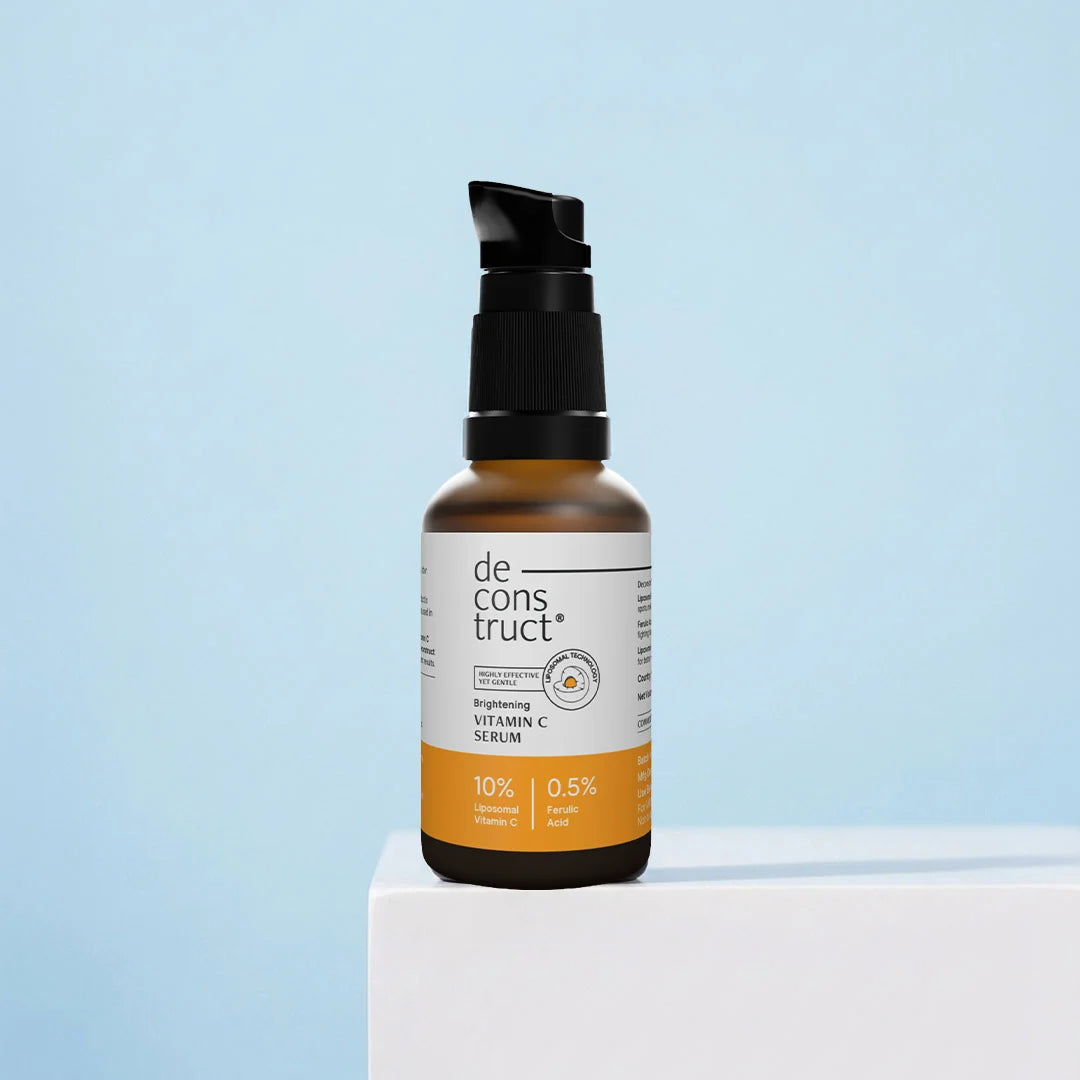
Deconstruct — Vitamin C + Ferulic Acid Serum
What Does Skin Brightening Actually Mean?
Brightening vs Skin Lightening
The two terms get used interchangeably, but in skincare they're not the same thing. Brightening agents work to restore your skin's natural glow and improve overall radiance. Lightening agents take a different route — they alter the skin's pigment to change its tone or aggressively fade spots. A brightening serum isn't trying to make you a different shade. It's working to bring back the clarity and luminosity dullness has flattened.
Common Concerns Brightening Serums Target
A brightening serum is built to improve the look of dullness and uneven tone so skin appears more radiant over time. Most people reach for one when dealing with:
- Dull, flat-looking skin that lacks glow
- Uneven tone from sun exposure or post-inflammatory changes
- Post-acne marks — the dark spots left behind after breakouts clear
- A general lack of radiance that moisturiser alone can't fix
The 4 Factors That Make a Brightening Serum Effective
Molecular Stability
Concentration isn't the whole story. Actives are volatile by nature, and pairing them with the right stabilising ingredient often matters more than the number on the label — something most brands gloss over. Pure vitamin C is a clear example: left unprotected, it oxidises in the bottle and stops delivering the results it claims. Research shows that pairing it with ferulic acid, a natural stabiliser, improves the chemical stability of vitamin C and doubles its photoprotection on the skin (Lin et al., Journal of Investigative Dermatology, 2005). Our explainer on how a vitamin C serum works goes deeper into why formulation beats raw percentage.
Multi-Pathway Targeting
Melanin production isn't a single switch. It's a multi-step biological process, which is why serums formulated to act on several pathways at once tend to outperform single-action formulas.
Advanced Delivery Systems
Premium serums use technology like a liposomal delivery system, which wraps the active in microscopic lipid bubbles that mirror the skin's own membrane. That lets the ingredient penetrate properly and target discolouration closer to the source. We cover the science in our guide to why liposomal skincare technology matters.
Barrier Repair Actives
Healthy skin is the foundation every active depends on. Pairing a brightening serum with barrier-supporting ingredients — like Centella Asiatica (cica) to calm inflammation and panthenol to hydrate and prompt cells to synthesise protective lipids — keeps the skin resilient enough to tolerate daily use [MDPI, skin barrier research].
Bonus Factor: Daily Sunscreen Use
No brightening serum can outrun daily UV exposure. Sun is the single biggest driver of melanin production, so even the best vitamin C needs SPF as its teammate every morning to hold onto the progress it's making.
| Factor | Why It Matters |
|---|---|
| Molecular stability | Formulation matters more than a higher ingredient concentration |
| Multi-pathway targeting | Addresses the biological complexity of melanin production |
| Advanced delivery system | Improves penetration so cumulative daily use drives visible results |
| Barrier repair actives | Protects the skin barrier by replenishing vital lipids |
| Sunscreen | Prevents UV from reversing brightening progress |
Why Vitamin C Remains a Gold-Standard Brightening Ingredient
What Vitamin C Does
Vitamin C is a water-soluble micronutrient that works on several fronts at once. It blocks tyrosinase, the enzyme that drives melanin overproduction, while acting as a powerful antioxidant shield against UV and environmental ageing. It also supports collagen synthesis, which improves elasticity and softens the look of fine lines.
Why Dermatologists Often Recommend It
Research has shown vitamin C to be effective at fading dark spots over time, especially when used alongside daily sunscreen to keep melanin production in check. Dermatologists tend to recommend it not only for brightening but for the protective, multi-benefit role it plays in a routine. If you're weighing it against other actives, our comparison of alpha arbutin vs vitamin C and brightening serum vs vitamin C serum are useful next reads.
Who May Benefit Most
- Skin that looks dull or flat despite consistent hydration
- Uneven complexion with patches of discolouration or inconsistent tone
- Post-acne marks that take longer than expected to fade
- Anyone regularly exposed to UV, pollution or environmental stress
Product Recommendation: Deconstruct 10% Vitamin C Serum
Why It Fits the Characteristics of an Effective Brightening Serum
Vitamin C works at the cellular level of melanin production, but its instability means a poorly formulated serum oxidises before it can deliver. Deconstruct's 10% Vitamin C Serum is built to solve exactly that. Ferulic acid acts as a natural stabiliser, cica extract calms any inflammation or redness that could irritate the barrier, and panthenol helps the skin retain water to offset the drying potential of an acidic active. Every component has a job, and they work together rather than competing.
Product Deconstruction
- 10% Liposomal Vitamin C: Sits in the clinically effective range — strong enough for visible results, gentle enough for daily use. Brightens dull skin, improves radiance and helps reduce pigmentation, with enhanced stability and deeper penetration.
- 0.5% Ferulic Acid: A natural stabiliser that extends the shelf life of vitamin C and keeps it from oxidising.
- 0.5% Centella Asiatica Extract: Calms the skin and reduces redness without causing dryness or sensitivity.
- 0.25% Panthenol: A humectant that draws water to the upper layers of skin to keep it hydrated.
The lightweight texture absorbs quickly and layers cleanly under moisturiser and SPF, removing the friction that often turns a good routine into an inconsistent one. For anyone new to vitamin C, or rethinking a routine that hasn't delivered, it's a stable, practical, daily-use-friendly option built around one of skincare's most trusted brightening ingredients. If you've had bad experiences with vitamin C before, our guide on whether vitamin C can cause breakouts explains why formulation, not the ingredient, is usually the culprit.
Who May Benefit?
- Anyone with dull or uneven-looking skin shopping for a first vitamin C serum
- Those dealing with post-acne marks or sun-related pigmentation
- First-time active users who want results without high irritation risk
- Anyone looking to simplify their brightening routine around one well-formulated product
How to Get the Most Out of Your Brightening Serum
Morning Routine
- Gentle cleanser
- Deconstruct 10% Vitamin C Serum
- Lightweight moisturiser
- Broad-spectrum SPF 50+
Best Practices
- Apply every morning without skipping — consistency is what drives cumulative results.
- Store away from direct sunlight and heat to preserve formula stability.
- Wear sunscreen every single day; it protects the brightening progress your serum is building.
- Give it at least six weeks before judging results — brightening is gradual by nature.
- Avoid switching products frequently; changing serums every few weeks resets your progress.
Common Reasons Brightening Serums Fail
Inconsistent Application
Brightening is cumulative. Using a serum a few times a week instead of daily stretches the timeline for visible change and makes it almost impossible to tell whether the product is even working.
Skipping Sunscreen
The most common reason brightening routines fall flat. UV exposure darkens pigmentation faster than most actives can fade it, so without SPF, results will always be slower and less visible than they should be.
Expecting Instant Results
Skin cell turnover takes roughly 28 days, and brightening follows that cycle. Expecting visible change in one or two weeks leads people to abandon products that would have worked with a little more time.
Choosing Products Based Only on High Percentages
A 20% vitamin C serum that has oxidised in its packaging delivers less than a stable 10% formula used daily. Formulation quality and packaging integrity matter as much as the number on the label — a point worth keeping in mind when you browse the wider Deconstruct face serum range.
The Takeaway
Brightening serums dominate skincare conversations, and vitamin C keeps coming out on top — rightly so. It targets melanin at a cellular level and forms a protective antioxidant layer that works hand in hand with sunscreen. Somewhere in the marketing noise, though, the focus drifted to chasing the highest vitamin C percentage instead of asking which formulation actually delivers.
Traditional serums lean on high concentrations of pure vitamin C that oxidise and evaporate before they can do anything. The better approach, and the one dermatologists tend to favour, is a lower, stable concentration in an advanced formula that penetrates properly. Deconstruct's 10% Vitamin C Serum is a stable, well-formulated and beginner-friendly place to start — science-backed, gentle on skin, and built to deliver the brightening results the percentage on a label alone never could.
FAQs
Do brightening serums actually work?
Yes — when the right ingredients are used consistently and paired with daily SPF. Vitamin C, niacinamide and alpha arbutin all have strong evidence behind their brightening effects, but results take weeks of daily use, not days.
How long does it take to see results from a brightening serum?
Surface dullness often improves within 2 to 4 weeks. Deeper concerns like post-acne marks or sun pigmentation usually take 6 to 12 weeks of consistent daily use to show meaningful change.
Is vitamin C the best ingredient for brightening skin?
It's one of the most well-researched and widely recommended. Its mix of melanin inhibition, antioxidant protection and collagen support makes it uniquely versatile — though pairing it with niacinamide or alpha arbutin delivers more comprehensive results for stubborn pigmentation.
Can I use a brightening serum every day?
Yes, and you should. Brightening serums, vitamin C especially, are designed for daily morning use. Consistent application is what produces the cumulative results that occasional use can't.
Why is sunscreen important when using a brightening serum?
UV exposure stimulates melanin production — the exact process brightening actives are trying to slow. Without SPF, your skin is being pigmented faster during the day than your serum can address overnight. Sunscreen is what makes a brightening routine work.