

Does Vitamin C actually work for oily skin, or is it just marketing? Some claims hold up, some are overstated, and one common belief is flatly wrong. It genuinely helps with dullness, uneven tone and post-acne marks — but it won't control oil, replace sunscreen, or work overnight. This is a claim-by-claim audit of what's actually backed by evidence versus what's just good copywriting.
Vitamin C gets pitched hard in skincare marketing, and oily skin is often told it "needs" the ingredient without much explanation of why — or what it genuinely can't do. Rather than another benefits list, this is a closer look at the specific claims made about Vitamin C and oily skin, sorted into what holds up and what doesn't.
Claim: "Vitamin C Isn't Suitable for Oily Skin"
Verdict: Mostly outdated. This belief comes from pure L-ascorbic acid — the original, highly acidic form of Vitamin C, which can genuinely irritate and doesn't sit well in oily skin routines. But that's a formulation problem, not an ingredient problem. Stable, gentler derivatives like 3-O-Ethyl Ascorbic Acid deliver the same core benefits with far less irritation risk, in water-based formulas designed specifically not to add oil or heaviness. Judging Vitamin C by its harshest form is like judging all sunscreen by the worst greasy one you've tried.
Claim: "Vitamin C Prevents Blackheads by Stopping Oil Oxidation"
Verdict: Plausible and mechanistically sound, but oversold as a primary use case. Oily skin contains squalene, a lipid that can oxidise into a comedogenic byproduct when exposed to UV and pollution — a real contributor to blackheads and congestion (Condrò et al., Pharmaceuticals, 2023). As an antioxidant, Vitamin C neutralises the free radicals that drive this oxidation (Topical Vitamin C: Mechanisms of Action, PubMed, 2017), so the mechanism checks out. But this is a supporting benefit, not Vitamin C's main job — if blackheads and congestion are your primary concern, an exfoliant like salicylic acid is the more direct, better-evidenced tool.
Claim: "It Fades Dark Spots and Brightens Dullness"
Verdict: Genuinely well supported. This is Vitamin C's strongest, most evidence-backed claim. It inhibits tyrosinase — the enzyme that drives melanin production — which is why it helps fade post-acne marks and uneven tone with consistent use (PubMed, 2017). Skin also looks more radiant fairly early on, thanks to its antioxidant effect on the complexion, even before pigmentation visibly improves.
Claim: "It Controls Oil Production"
Verdict: False. This is the one claim worth calling out directly, because it's a common assumption rather than an actual marketing promise. Vitamin C is not a sebum regulator — it doesn't reduce how much oil your skin produces. If oil control is your primary goal, niacinamide is the ingredient with clinical evidence behind it for that specific job (Draelos et al., 2006), not Vitamin C. See our niacinamide guide for oily skin if oil is your main concern.
Claim: "You'll See Results Fast"
Verdict: False, and one of the more misleading claims in skincare marketing generally. Vitamin C works alongside the skin's natural renewal cycle. Genuine, visible change in tone and pigmentation typically takes 4–8 weeks of consistent daily use — not days. Any messaging implying overnight results is setting expectations that will lead to the product being abandoned before it's had a chance to work.
Claim: "It Replaces the Need for Sunscreen"
Verdict: False, and a genuinely important one to correct. Vitamin C is an antioxidant, not a UV filter. It neutralises free radical damage but does not block or absorb UV rays. Skipping SPF because you're using Vitamin C actively works against the serum — UV keeps generating the melanin and oxidative stress Vitamin C is trying to counter. Daily broad-spectrum sunscreen is non-negotiable alongside it.
The Honest Scorecard
| Claim | Verdict |
|---|---|
| Not suitable for oily skin | Mostly false — depends on the derivative |
| Prevents blackheads via oxidation | Plausible, but a secondary benefit |
| Fades dark spots and dullness | Well supported |
| Controls oil production | False |
| Works fast | False |
| Replaces sunscreen | False |
Recommended Product: Deconstruct 10% Vitamin C Serum
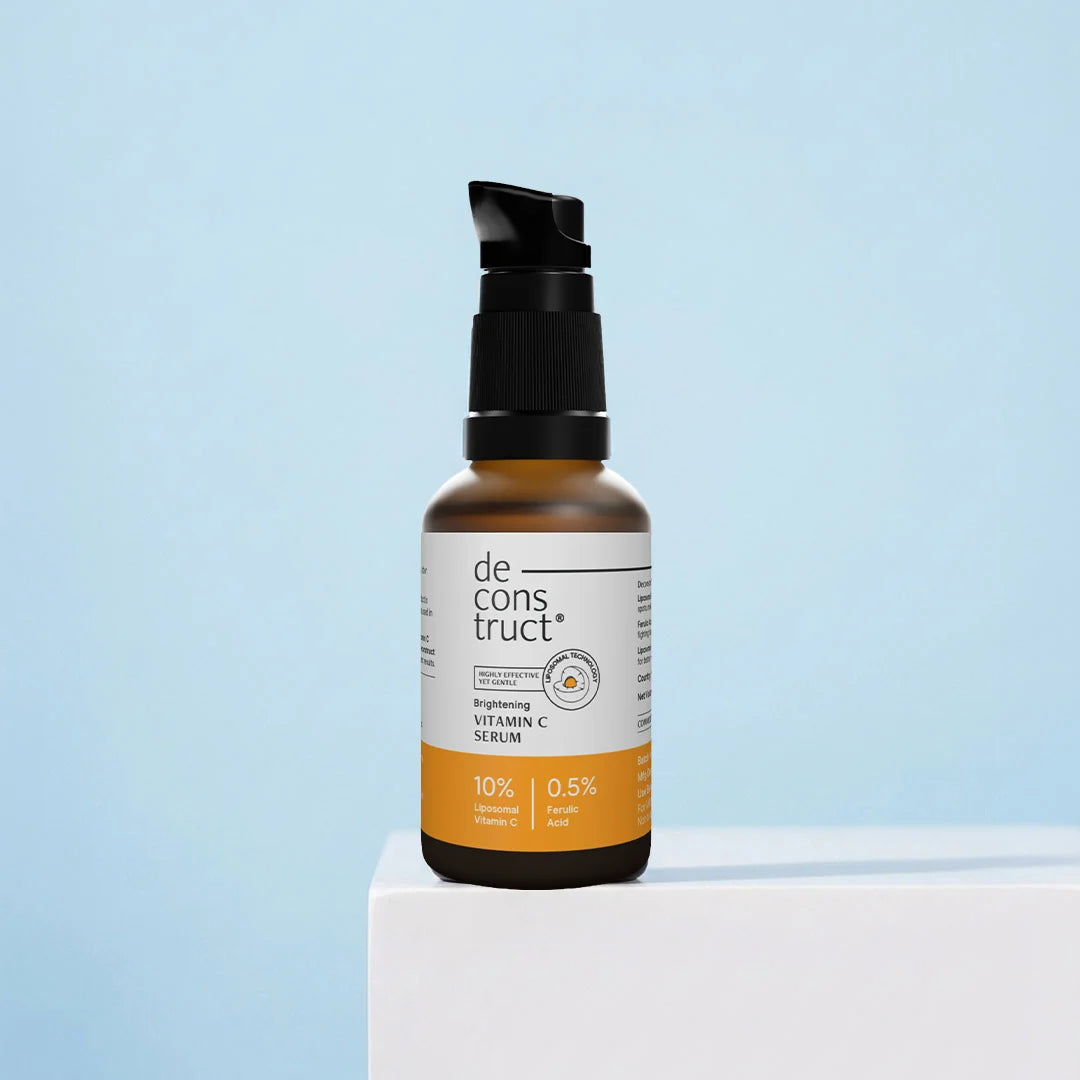
Deconstruct — Vitamin C + Ferulic Acid Serum
If you're addressing the claims that actually hold up — dullness, uneven tone, post-acne marks — Deconstruct's 10% Vitamin C Serum is built around exactly the formulation choices that make the difference for oily skin.
- 10% Liposomal Vitamin C — a stable derivative at a clinically effective, low-irritation concentration
- Lightweight, fast-absorbing formula that leaves no residue or shine — addressing the "not suitable for oily skin" claim head-on
- Layers cleanly under moisturiser and sunscreen, so SPF still sits evenly on top
- Supports genuine, evidence-backed benefits: radiance, tone and post-acne marks, not oil control
Who Should Use It
- Oily and combination skin dealing with dullness or uneven tone
- Anyone with post-acne marks looking for antioxidant, brightening support
- Beginners introducing their first Vitamin C serum
Who shouldn't rely on it alone: anyone whose primary concern is oil control or active congestion — pair it with niacinamide or salicylic acid for those goals instead.
How to Use It Without Falling for the Wrong Claims
Morning
- Gentle cleanser
- Deconstruct 10% Vitamin C Serum
- Lightweight, oil-free moisturiser
- SPF 50+ (non-negotiable, not optional)
Evening
Vitamin C works best in the morning alongside daytime UV and pollution defence. In the evening, focus on your targeted treatment — niacinamide for oil and marks, or a gentle exfoliant for congestion — followed by a lightweight moisturiser.
Final Thoughts
Vitamin C for oily skin isn't a scam, but it isn't a miracle either — it's a well-evidenced tool for a specific job. It genuinely fades dark spots, improves dullness and supports radiance, provided you use a stable, lightweight derivative and give it time. What it won't do is control oil, replace sunscreen, or work overnight — and any claim suggesting otherwise deserves scepticism. Judged on the claims that actually hold up, Deconstruct's 10% Vitamin C Serum is a solid, evidence-aligned choice for oily skin's dullness and pigmentation concerns.
FAQs
Is it true that Vitamin C isn't good for oily skin?
No, that's mostly outdated. Pure L-ascorbic acid can irritate oily skin, but stable, water-based derivatives like Ethyl Ascorbic Acid deliver the same benefits without the heaviness or irritation risk.
Does Vitamin C control oil production?
No. Vitamin C is an antioxidant, not a sebum regulator. If oil control is your main goal, niacinamide is the better-evidenced ingredient for that specific concern.
Can Vitamin C replace sunscreen?
No. Vitamin C provides antioxidant protection but doesn't filter UV rays. Daily broad-spectrum sunscreen is still essential alongside it, not instead of it.