

What's the best serum for oily skin? There isn't one — because oily skin is a skin type, not a skin concern. The right serum depends entirely on what you're actually trying to fix: dullness calls for Vitamin C, post-acne marks and pigmentation call for Niacinamide with Alpha Arbutin, and congestion or blackheads call for Salicylic acid. This guide is a decision framework — identify your concern first, then pick the serum built for it.
The serum that transforms someone's flat, dull complexion won't necessarily help someone else whose main issue is congested pores or post-acne marks. This guide cuts through the noise and helps you choose based on what your skin actually needs — not what's trending on your feed.
Why Oily Skin Benefits From Serums
Lightweight Yet Targeted
Serums are arguably the best format for oily skin, and that's not an accident. Because they skip the heavy emollients that give creams and lotions their thick texture, serums carry active ingredients at meaningful concentrations in a lightweight, water- or gel-based base — actives that sink in rather than sit on top, without adding the surface weight oily skin tends to react against.
Choosing Ingredients Based on Skin Goals
Your serum's ingredient should be chosen based on your primary concern — not the percentage on the label or what's trending. For oily skin, concerns typically map like this:
| Concern | Ingredient to Look For |
|---|---|
| Dullness and lack of radiance | Vitamin C |
| Post-acne marks and PIH | Niacinamide + Alpha Arbutin |
| Congested pores and blackheads | Salicylic Acid |
| Excess oil | Niacinamide |
How to Choose the Right Serum for Oily Skin
If Your Concern Is Dullness
If skin looks flat or tired despite being well-hydrated, dullness is your concern and Vitamin C is the ingredient. It's one of the most well-researched brightening actives, working by inhibiting melanin production and neutralising free radicals from UV and pollution (Topical Vitamin C: Mechanisms of Action, PubMed, 2017). For oily skin specifically, dermatologists favour a stable derivative — Sodium Ascorbyl Phosphate or Ethyl Ascorbic Acid — over pure L-ascorbic acid, which is more likely to irritate.
If Your Concern Is Post-Acne Marks
Oily skin's tendency toward congestion and inflammation drives more melanin production, which shows up as post-acne marks and pigmentation. A serum combining Niacinamide and Alpha Arbutin is the strongest choice here — niacinamide limits how much melanin reaches the surface, while alpha arbutin reduces production at the source. We cover this dual-pathway approach in detail in our niacinamide guide for oily skin.
If Your Concern Is Congested Skin
Blackheads, clogged pores and rough texture respond best to a chemical exfoliant like salicylic acid, which penetrates the pore lining to dissolve the sebum and dead-cell buildup causing the blockage (Arif, Clinical, Cosmetic and Investigational Dermatology, 2015). If congestion is your primary issue, a pore-focused serum like Deconstruct's Salicylic Acid Pore Control Serum is the more appropriate choice than a brightening one.
Identifying your primary concern first means choosing a serum that actually addresses what you're dealing with, rather than one that sounds good but targets something else entirely.
Recommended Product: Deconstruct 10% Vitamin C Serum
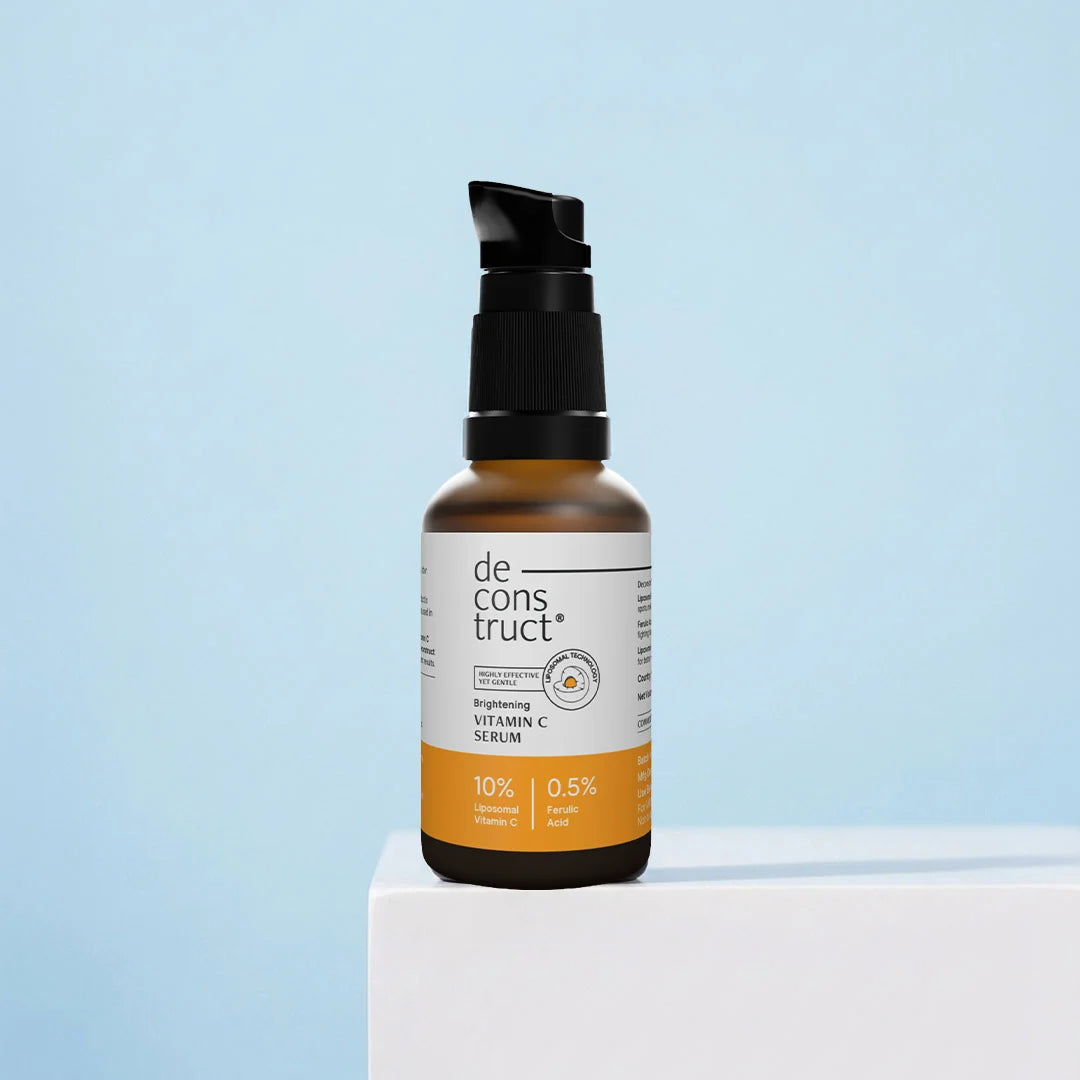
Deconstruct — Vitamin C + Ferulic Acid Serum
Best Choice for Dull and Uneven-Looking Skin
For oily-skin users whose primary concern is dullness or a tired-looking complexion, Deconstruct's 10% Vitamin C Serum is the strongest everyday recommendation.
- 10% Liposomal Vitamin C — a stable derivative at a concentration proven effective for brightening and antioxidant protection, gentle enough for daily oily-skin use without a high irritation risk
- Lightweight texture that absorbs quickly without adding shine or surface weight, and layers cleanly under moisturiser and sunscreen
- Supports brighter-looking skin with consistent morning use, visibly improving radiance and surface pigmentation over 4–6 weeks
- Beginner-friendly — 10% is an accessible starting concentration that doesn't require building up gradually
For the full ingredient breakdown and how it compares to other brightening picks, see our dedicated guide on Vitamin C serum for brightening skin.
Who Should Choose It?
- Oily and combination skin dealing with dullness or a flat-looking complexion
- Uneven tone from sun exposure or environmental stress
- Beginners introducing their first active serum into a morning routine
- Anyone wanting daily antioxidant protection alongside brightening
How to Use a Serum in Your Routine
Morning
- Gentle cleanser
- Deconstruct 10% Vitamin C Serum
- Lightweight, oil-free moisturiser
- SPF 50+
Evening
- Gentle cleanser
- Treatment serum based on your concern — niacinamide for marks, salicylic acid for congestion
- Lightweight moisturiser
Morning is when Vitamin C delivers the most value — its antioxidant protection works best as a first line of defence against the UV and pollution your skin faces through the day. Explore daily sunscreens to complete the morning step.
Common Mistakes When Choosing a Serum
Following Social Media Trends
Social media has real influence on what people buy, but a product going viral doesn't mean it's right for your specific concern. Skincare works best as an informed choice, not an impulse one.
Ignoring Your Primary Skin Concern

Deconstruct — Clearing Serum
Using a brightening serum when your real issue is congestion, or a pore-clearing serum when your issue is dullness, means the product is targeting the wrong problem. Identifying your primary concern first is the single most important step in serum selection.
Using Too Many Actives at Once
Layering vitamin C, niacinamide, salicylic acid and retinol together before your skin has adjusted to any of them is a common route to irritation and reactive breakouts. Start with one serum, use it consistently for six weeks, then consider adding a second if needed.
Final Thoughts
There's no single best serum for oily skin — there's a best serum for your oily skin, based on what you're trying to fix. As a quick reference: dullness pairs with Vitamin C, hyperpigmentation with Niacinamide and Alpha Arbutin, and congestion with Salicylic acid. Because of their low molecular weight, serums are the ideal format for delivering these actives to oily skin without adding heaviness. If brightening is your goal, Deconstruct's 10% Vitamin C Serum is a practical, beginner-friendly starting point — use it consistently, and let the results tell you what to add next. Browse the full face serum range to match a formula to your concern.
FAQs
What is the best serum for oily skin in India?
It depends on your concern: Vitamin C for dullness, Niacinamide with Alpha Arbutin for post-acne marks and pigmentation, and Salicylic acid for congestion and blackheads. Identify your primary concern first, then choose the matching ingredient.
Can I use more than one serum for oily skin?
Yes, but introduce them one at a time. Start with a single serum, use it consistently for about six weeks, and only add a second active once your skin has adjusted — layering too many actives at once raises the risk of irritation.
Is Vitamin C serum good for oily, acne-prone skin?
Yes, provided it uses a stable, gentle derivative like Ethyl Ascorbic Acid rather than pure L-ascorbic acid, and sits in a lightweight, oil-free base. It's especially suited to oily skin dealing with dullness rather than active congestion.