

Two bottles of Vitamin C serum. Same concentration on the label. One goes yellow within a month, maybe two. The other stays clear until the last drop. Vitamin C itself is not the difference. What surrounds it inside the product is.What do we actually mean by it is what formulation is being used might just be the secret that changes how your serum performs. We still go by the myth that high concentration means faster results. Is formulation alone enough ? This guide is designed to answer all of your questions .
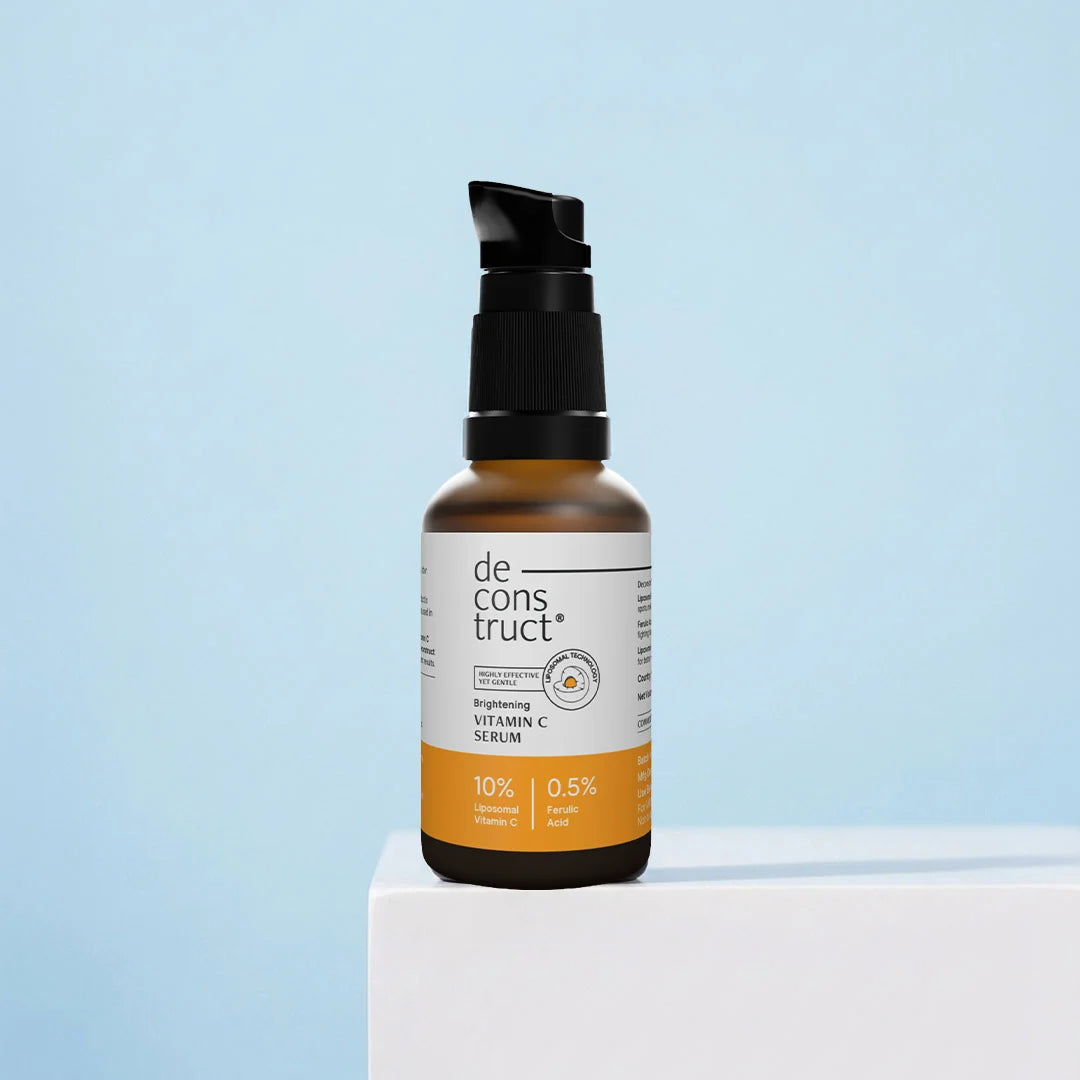
Deconstruct — Vitamin C + Ferulic Acid Serum
WHAT IS LIPOSOMAL TECHNOLOGY?
UNDERSTANDING LIPOSOMES IN SKINCARE
So what really is this Liposomal technology we have been raving about. Why exactly is it any better? The fatty molecules you see on the surface of your skin , which are the skin's natural membranes, are called phospholipids, now this is exactly what a liposome is made out of. Liposomes are microscopic spherical bubbles . In pharmacology and medicine this advanced delivery system is used to seep into the targeted cells. In advanced skincare delivery systems, Liposomal delivery system is used along with Vitamin C due to the highly unstable nature of pure Vitamin C , allowing the Vitamin C to deliver its benefits without degradation of the active ingredient Vitamin C.
(Source: IJPS)
WHY BRANDS USE LIPOSOMAL DELIVERY SYSTEMS
So why did the need for using this new delivery system take place? According to BOC sciences there were two primary reasons why the liposomal delivery system was introduced ,extreme chemical instability and poor skin penetration. We have already discussed the highly unstable nature of L-Ascorbic acid or pure Vitamin C, at a molecular level. By wrapping Vitamin C inside microscopic bubbles , how Vitamin C performs on the skin at a deeper level completely changes its efficiency level. With studies showing an improvement in encapsulation efficiency increasing up to 77-80%.(MDPI)
HOW LIPOSOMAL TECHNOLOGY SUPPORTS VITAMIN C FORMULATIONS
PROTECTING VITAMIN C WITHIN THE FORMULA
Vitamin C has been a cult favourite ingredient for years, recommended by dermatologists and clinical studies highlighting the benefits it provides because of its antioxidant properties, which provides its own electrons to neutralize free radicals. But the only major problem is the molecular nature of Vitamin C making it high unstable when it comes in contact with the oxygen in air. Using high-pressure homogenizers along with phospholipids, these molecules are encapsulated in microscopic bubbles trapping the Vitamin C inside liposomes which slowly dissolve in 8-12 hours as active antioxidants throughout the day.
SUPPORTING CONSISTENT APPLICATION
When the compound is enclosed in liposomes, distribution across the face during application is more uniform than a conventional free-suspension. Each point of contact receives an encapsulated compound rather than an uneven concentration. In practice, this means the brightening work happens across the full surface rather than in patches.
SUITABLE FOR EVERYDAY SKINCARE ROUTINES
Liposomal serums are typically water-based. The encapsulation handles the active compound without needing a heavy carrier. Products absorb quickly, leave no residue, and layer cleanly under moisturiser and SPF. For a morning routine with multiple steps, this matters.
HOW IS IT DIFFERENT FROM TRADITIONAL VITAMIN C SERUMS?
|
Traditional Vitamin C Serum |
Liposomal Vitamin C Serum |
|
Compound suspended freely in water or glycol base |
Compound enclosed within phospholipid carriers |
|
Direct air and light exposure once opened |
Encapsulation slows oxidation rate |
|
Texture determined entirely by the base |
Typically lightweight and water-based |
|
Standard cosmetic approach |
Advanced encapsulation technology |
A well-made conventional serum outperforms a poorly executed liposomal one. The technology is only as good as the formulation built around it.
RECOMMENDED PRODUCT: DECONSTRUCT 10% VITAMIN C SERUM WITH LIPOSOMAL TECHNOLOGY
WHY IT IS A MODERN FORMULATION
Deconstruct approached the stability problem from two directions. Their base compound is 3-O-Ethyl Ascorbic Acid rather than pure ascorbic acid, a Vitamin C derivative that is inherently more resistant to oxidation. Liposomal encapsulation adds a second layer of protection on top of that.
At 10%, the concentration falls within the range associated with visible brightening in published research. A 2013 review by Telang in the Journal of Clinical and Aesthetic Dermatology confirmed topical Vitamin C effective at reducing hyperpigmentation with consistent use at comparable levels.
Lightweight texture. Absorbs fully within a minute. No residue. Sits cleanly under moisturiser and SPF, which matters for daily morning use. On oily or combination skin, this is the format that makes consistent application realistic rather than aspirational.
Surface brightness typically begins shifting around weeks three and four. Deeper pigmentation takes closer to six to eight weeks of daily use.
WHO SHOULD CONSIDER A LIPOSOMAL VITAMIN C SERUM?
Beginners benefit because liposomal serums tend to be lighter and more comfortable to introduce into a new routine. Oily and combination skin types benefit for the same reason. Anyone already using Vitamin C without seeing expected results should ask whether their serum had already degraded before they finished it.
People who want to understand what separates two products with the same active on the label will find liposomal technology one of the few differences that genuinely explains performance variation.
COMMON MYTHS ABOUT LIPOSOMAL TECHNOLOGY
It changes what the Vitamin C does. Liposomes change how the compound is protected and distributed. Once it reaches its target, the Vitamin C performs identically to any other format.
It is only for sensitive skin. Liposomal delivery is a manufacturing approach, not a sensitivity solution. Lighter textures are a consequence, not the design goal.
All Vitamin C serums perform the same. Two products at identical percentages can behave very differently because of the base, the form of Vitamin C chosen, and whether encapsulation is involved. The percentage is one variable among several.
FINAL THOUGHTS
Liposomal technology addresses a specific problem: keeping a reactive compound stable and evenly distributed from the first application to the last. For Vitamin C, which degrades faster than most users realise, that matters considerably.
Deconstruct's 10% Vitamin C Serum with Liposomal Technology is built around this principle. A stable derivative, encapsulated for protection, in a lightweight format designed for daily morning use. Understanding formulation is what separates an informed product choice from a lucky one.