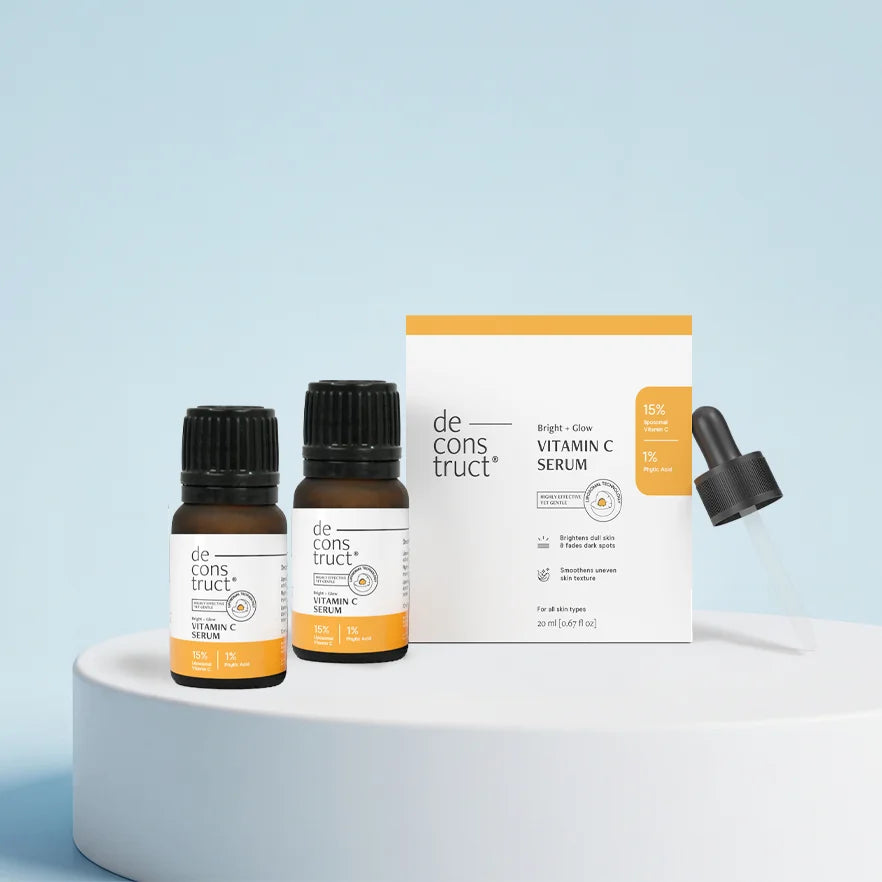

From a scientific point of view there is no evidence suggesting that Vitamin C makes skin oilier. However due to the formulation there are instances where people notice their skin oilier than it was before using Vitamin C. Traditional cosmetics tends to use Vitamin E or heavy oils to retain the stability of Vitamin C but maybe that is doing more harm. The solution is choosing the best formulation which breaks through the myths, this guide is curated for you to solve that purpose.
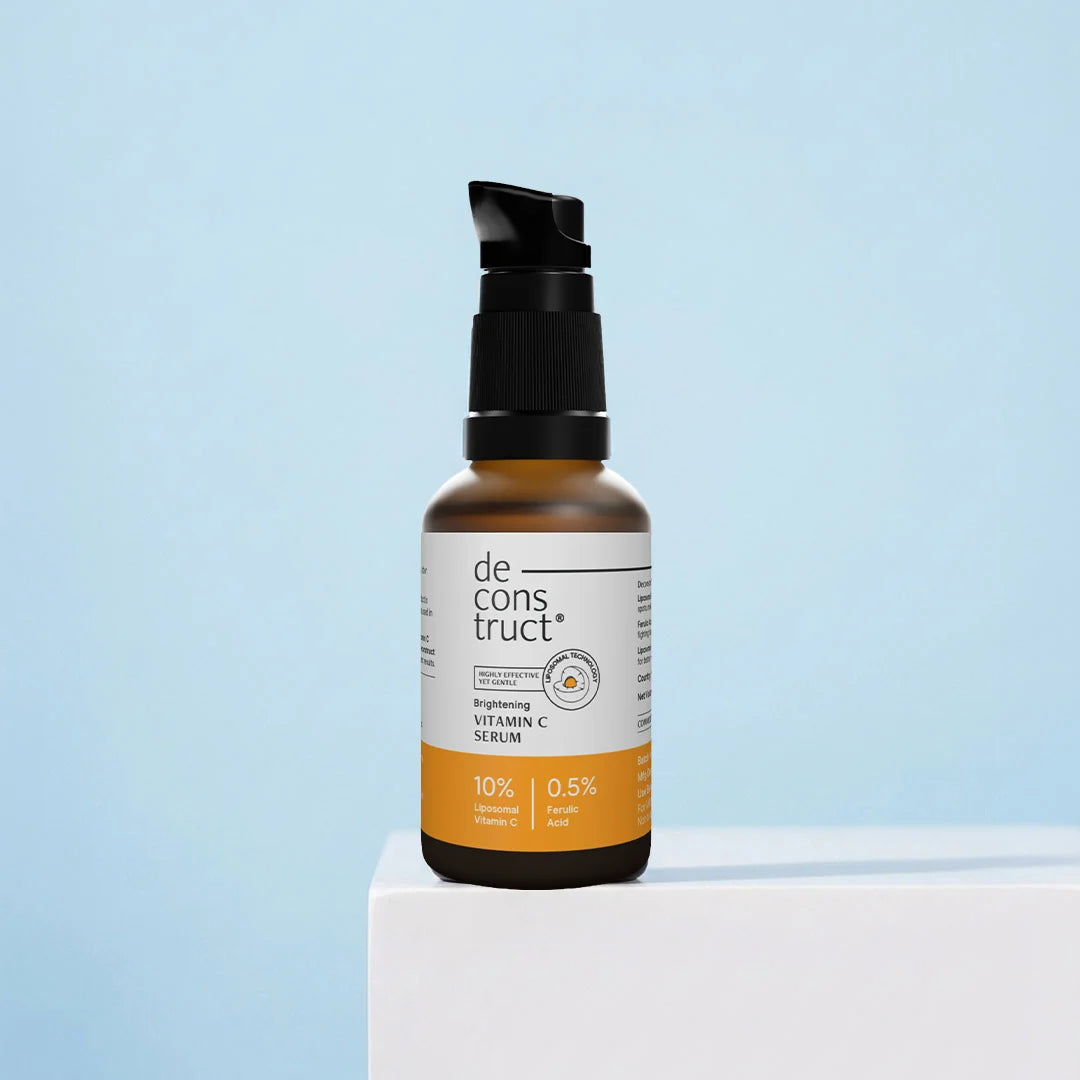
Deconstruct — Vitamin C + Ferulic Acid Serum
WHERE DOES THIS MYTH COME FROM?
CONFUSING RICH FORMULAS WITH THE INGREDIENT
Vitamin C serums exist on a wide spectrum of textures, from light, water-based fluids to thick, emollient creams. The heavy end of that spectrum genuinely doesn't suit oily skin. It sits on the surface, adds unwanted richness and can contribute to the congestion this skin type is already managing.
The mistake is attributing that experience to Vitamin C rather than to the formula. A lightweight water-based Vitamin C serum is a completely different product, same active ingredient, entirely different experience on oily skin.
PAST EXPERIENCES WITH THE WRONG PRODUCTS
Most people who believe Vitamin C made their skin worse tried a product formulated for dry or normal skin , often with richer supporting ingredients like plant oils or heavy emollients. On oily skin, those formulas land poorly. But that's a mismatch between product and skin type, not evidence that Vitamin C itself is the problem.
Switching to a formula designed for oily and combination skin changes the outcome entirely.
CAN VITAMIN C SERUM MAKE OILY SKIN WORSE?
The short answer is no , while there might be cases people witness Vitamin C making skin oily the major reason is the heavy oil bases which are used to stabilize Vitamin C ,its important to use a water based texture formula in order to avoid clogged pores and greasiness
WHAT ACTUALLY INFLUENCES HOW A SERUM FEELS?
FORMULA MATTERS MORE THAN THE INGREDIENT
Most cases where in Vitamin C failed to give the desired results to Oily skin is where the formulation was poor , expired serums that turn yellow or high concentrations that irritate the skin barrier. Look out for advanced formulations such as Sodium Ascorbyl Phosphate (SAP) or 3-O-Ethyl Ascorbic Acid. These next-generation derivatives operate at a skin-neutral pH which do not trigger any unwanted greasiness or pore clogging. Make sure to use water based formulations with humectants as base ingredients
(Source:National Library of Medicine)
SKIN TYPE AND ROUTINE ALSO MATTER
Even the right serum can feel wrong if the surrounding routine isn't balanced. Layering too many active ingredients increases the chance of irritation. Using a heavy moisturiser over a lightweight serum creates heaviness that gets attributed to the serum. Choosing a thick, cream-based sunscreen as the final step adds to an already loaded texture stack.
The serum is one variable. The routine it sits in is another. Evaluating them separately is what leads to more accurate conclusions about what's working and what isn't.
SIGNS YOU'RE USING THE WRONG SERUM
HEAVY, STICKY FINISH
If the serum feels sticky or heavy 60 seconds after application , before moisturiser or SPF go on , the formula isn't right for oily skin. A suitable serum should absorb completely and leave no surface awareness.
TOO MANY ACTIVE INGREDIENTS AT ONCE
Breakouts after starting a Vitamin C serum are often caused by adding it to a routine that already has multiple actives , acids, retinol, niacinamide , rather than by the Vitamin C itself. Introducing one new product at a time makes it possible to identify exactly what the skin is responding to.
SKIPPING A PATCH TEST
Applying a new serum directly to the full face without a patch test makes it harder to distinguish between a genuine reaction to the ingredient and a sensitivity to a supporting ingredient in the formula. A 24-hour patch test on the inner arm before full-face application reduces that uncertainty.
RECOMMENDED PRODUCT: DECONSTRUCT 10% VITAMIN C SERUM
WHY IT'S SUITABLE FOR OILY SKIN
If the concern about Vitamin C is texture , that it might feel heavy, greasy, or congesting , Deconstruct's 10% Vitamin C Serum addresses that directly.
10% Vitamin C (3-O-Ethyl Ascorbic Acid): A stable derivative that delivers full brightening and antioxidant benefits without the rapid oxidation of pure L-ascorbic acid. Effective at 10% for daily oily skin use.
Lightweight, fast-absorbing formula: Absorbs within seconds, leaves no residue or shine. This is the formulation detail that determines whether a Vitamin C serum actually gets used daily on oily skin and daily use is what produces results.
Suitable for oily and combination skin: Non-comedogenic, no heavy supporting ingredients, no congestion risk.
Comfortable for daily wear: Designed to be applied every morning as step two in the routine, absorbing fully before moisturiser and SPF go on top.
Supports brighter-looking skin and improved uneven tone: With consistent morning use, visible improvements in dullness and pigmentation typically build within 4 to 8 weeks.
For oily skin users who've avoided Vitamin C due to texture concerns, this is the formula worth trying.
MYTH VS FACT
|
Myth |
Fact |
|
Vitamin C increases oil production |
Vitamin C doesn't stimulate sebum production. How a serum feels is determined by its formulation, not the active ingredient |
|
Vitamin C always causes breakouts |
Breakouts after introducing a serum often stem from unsuitable formulation, over-stacking actives, or skipping a patch test , not Vitamin C itself |
|
Oily skin doesn't need Vitamin C |
Oily skin faces the same UV exposure and environmental stress as every other skin type. Antioxidant protection and brightening support are relevant regardless of skin type |
HOW TO INTRODUCE VITAMIN C CORRECTLY
MORNING
-
Gentle cleanser
-
Lightweight oil-free moisturiser
-
SPF 50+
Beginners: start with 3 - 4 applications per week and build to daily as skin adjusts. Introduce it as the only new product in the routine , not alongside a new moisturiser, new SPF and new actives simultaneously.
FINAL THOUGHTS
Vitamin C doesn't make oily skin worse. Heavy formulas do and that's a product problem, not an ingredient problem. The right Vitamin C serum for oily skin is lightweight, fast-absorbing and non-comedogenic. Used correctly as part of a balanced morning routine, it provides antioxidant protection and visible brightening without adding anything oily skin doesn't need.
Deconstruct's 10% Vitamin C Serum is a practical option for oily skin users looking to add Vitamin C without the texture concerns , stable, lightweight and designed for the daily consistency that delivers results.
FAQs
DOES VITAMIN C INCREASE OIL PRODUCTION?
No Vitamin C cannot directly increase oil production according to science.However due to poor formulation with heavy base oils clogged pores can cause oil production.
CAN VITAMIN C CLOG PORES ON OILY SKIN?
Not inherently. Pore congestion from a serum is typically caused by comedogenic supporting ingredients in the formula, not by Vitamin C. A non-comedogenic, water-based formula doesn't carry this risk.
WHY DID MY OILY SKIN BREAK OUT AFTER USING VITAMIN C?
If you are having breakouts after applying Vitamin C which is a very skin friendly active, the most likely reason is poor formulation or using a high concentrated Vitamin C bottle. 3-O-Ethyl Ascorbic Acid, a derivative form tackles these issues while also making Vitamin C effective.
IS 10% VITAMIN C SUITABLE FOR OILY SKIN BEGINNERS?
Yes, 10% is recommended by dermatologists and is proven to be clinically effective for brightening, gentle enough for daily use and less likely to cause irritation for oily skin beginners.
HOW DO I KNOW IF A VITAMIN C SERUM IS RIGHT FOR MY OILY SKIN?
Check for three things: lightweight water-based texture, non-comedogenic formulation and a stable Vitamin C derivative like 3-O-Ethyl Ascorbic Acid. Patch test before full-face application .