

Can oily skin use vitamin C serum? Yes — and it's genuinely beneficial. Vitamin C's antioxidant action helps stop sebum from oxidising (one of the triggers behind blackheads and breakouts), fades post-acne marks and brightens dullness. The key is the formula: a lightweight, water-based serum using a stable, gentle derivative like 3-O-Ethyl Ascorbic Acid, rather than a heavy or harshly acidic pure vitamin C.
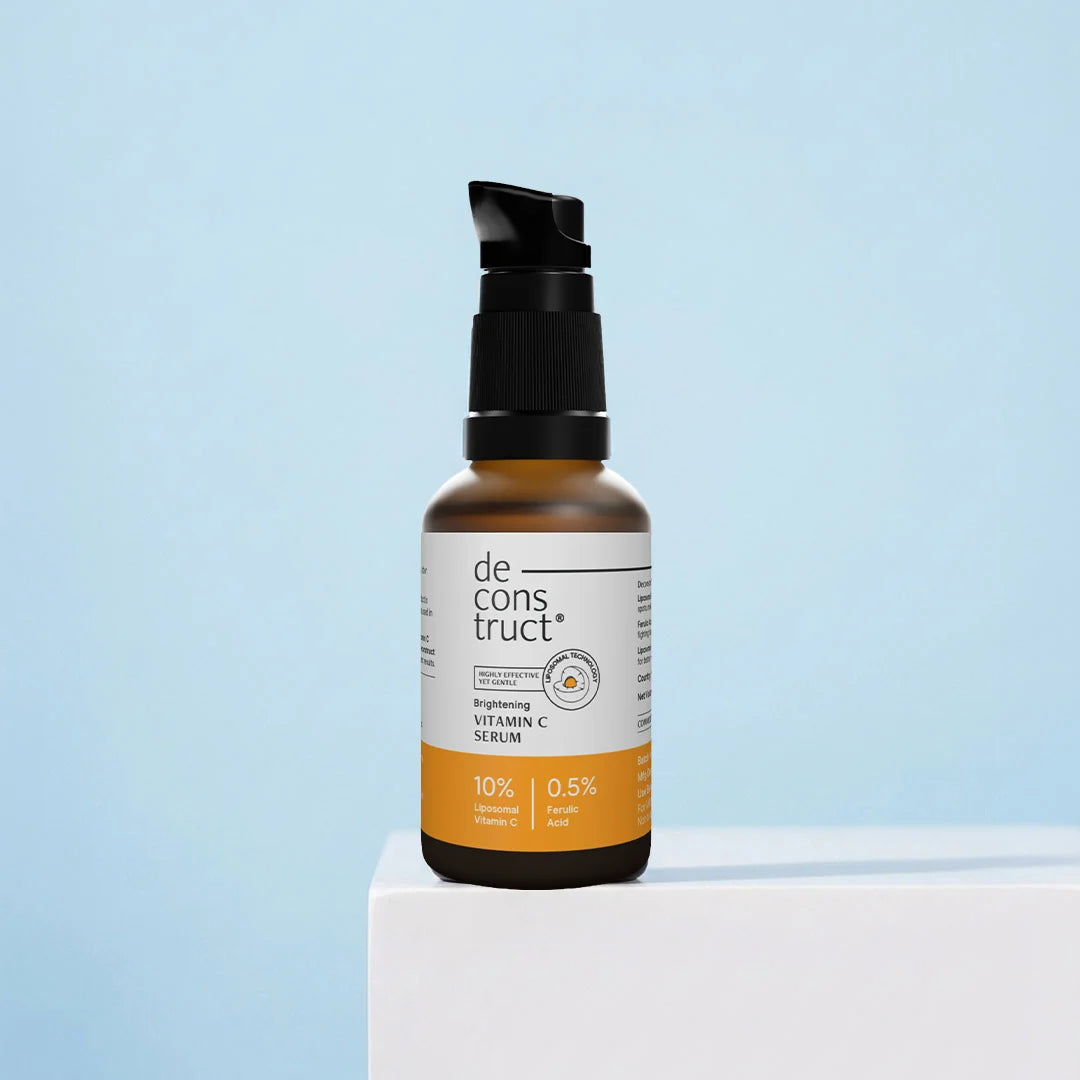
Deconstruct — Vitamin C + Ferulic Acid Serum
There's good reason oily skin benefits here. Sebum from oily, acne-prone skin is highly vulnerable to oxidative stress. When excess sebum meets UV and urban pollution, its squalene content undergoes lipid peroxidation, forming squalene peroxide — a comedogenic byproduct linked to clogged pores and inflammation in acne-prone skin (Condrò et al., Pharmaceuticals, 2023, via PubMed). An antioxidant like vitamin C directly addresses that.
Understanding Oily Skin
What Causes Oily Skin?
The primary cause of oily skin is overproduction of sebum by the sebaceous glands. Other factors influence it too:
- Genetics: the tendency toward oily skin is largely inherited.
- Hormonal influences: androgens stimulate sebum, which is why oiliness peaks during puberty, hormonal shifts and stress.
- Climate: heat and humidity accelerate sebum production.
Common Oily Skin Concerns
- Blackheads and whiteheads from congestion
- More frequent acne breakouts
- Enlarged pores
- Post-acne marks
What Does Vitamin C Do for Skin?
Vitamin C as an Antioxidant
Vitamin C is a clinically studied antioxidant that neutralises free radicals — unstable molecules — before they can oxidise surface sebum. It works as an electron donor, reducing cellular damage (Topical Vitamin C: Mechanisms of Action, PubMed, 2017). In its harshly acidic pure form, though, it can irritate, which is why formulation matters for oily skin.
Brightening Benefits
- Inhibits tyrosinase to block melanin production and reduce new dark spots
- Neutralises free radicals from UV, pollution and smoke
- Supports collagen synthesis for smoother, plumper texture
- Helps prevent sebum oxidation, reducing blackheads
Overall Skin Appearance
By supporting cell turnover while blocking melanin production and free-radical damage, vitamin C helps transform dull, fatigued skin into a firmer, more radiant complexion over time.
Can Oily Skin Use Vitamin C Serum? What Experts Say
Vitamin C has been a cult favourite for years, but for oily skin, dermatologists suggest keeping a couple of criteria in mind:
- The right derivative: Sodium Ascorbyl Phosphate (SAP) or 3-O-Ethyl Ascorbic Acid are the most suitable, stable forms for oily skin, with less irritation risk than pure L-ascorbic acid (Iliopoulos et al., via NCBI, 2019).
- Water-based texture: oily skin doesn't need added oil, so a lightweight, non-comedogenic base is essential.
Benefits for Oily Skin
- Antioxidant shield that stops oil from oxidising, reducing blackheads
- Soothes inflammation linked to active breakouts
- Supports collagen, which helps minimise the look of enlarged pores
- Fades post-acne marks by inhibiting the melanin-producing enzyme
Choosing the Right Formula Matters
| Myth | Fact |
|---|---|
| Vitamin C is only for dry skin | It suits all skin types when the formula is right |
| Serums make oily skin greasier | Texture matters — lightweight serums don't add shine |
| Antioxidants only benefit ageing or dry skin | Antioxidant protection benefits every skin type |
| Vitamin C causes breakouts in everyone | Responses vary; most oily skin tolerates a good formula well |
What to Look for in a Vitamin C Serum for Oily Skin
Lightweight Texture
Choose a lightweight, water-based, non-comedogenic serum. Heavy oils trap natural sebum and lead to congestion and clogged pores — exactly what oily skin doesn't need.
The Right Derivative
Because pure vitamin C is highly acidic, a stable derivative is the safer choice to avoid irritation and the pigmentation it can sometimes trigger. Sodium Ascorbyl Phosphate (SAP) and 3-O-Ethyl Ascorbic Acid are the dermatologist favourites for oily skin.
Suitable Concentration
A 10–15% concentration is widely considered the clinically effective sweet spot — potent enough to work, gentle enough for daily use.
Product Recommendation: Deconstruct 10% Vitamin C Serum
Why It May Be Suitable for Oily Skin
Deconstruct's 10% Vitamin C Serum is built on a simple principle: effective vitamin C doesn't need to feel heavy or complicated. It's a lightweight, water-based formula using a stable, liposomal ethyl ascorbic acid form of vitamin C, with calming agents to limit irritation — a practical fit for oily and combination skin.
- 10% Liposomal Vitamin C penetrates effectively to brighten, reduce dullness, target pigmentation and improve radiance.
- 0.5% Ferulic Acid boosts vitamin C's performance, protects against oxidative stress and roughly doubles its photoprotection (Lin et al., J Invest Dermatol, 2005).
- 0.5% Centella Asiatica Extract calms the skin and reduces redness.
- 0.25% Panthenol hydrates and supports the barrier.
Who May Benefit?
- Oily and combination skin types
- Those with dull or uneven skin tone
- Anyone dealing with post-acne marks
- Beginners starting their first vitamin C routine
New to the ingredient? Our guide on how a vitamin C serum works is a good starting point.
How to Use Vitamin C Serum in an Oily Skin Routine
Morning
- Gentle cleanser
- Deconstruct 10% Vitamin C Serum
- Lightweight, non-comedogenic moisturiser
- SPF 50+
Evening
- Gentle cleanser
- Lightweight moisturiser
Morning is the ideal time for vitamin C on oily skin — its antioxidant protection works best as a daytime defence against UV and pollution, and pairing it with SPF creates a more complete protective routine than either alone.
Common Mistakes Oily Skin Users Make
Using Too Many Actives at Once
Layering vitamin C with acids, retinol and strong exfoliants before your skin is used to any of them is a fast track to irritation and reactive breakouts. Introduce one active at a time and build gradually.
Skipping Moisturiser
Even oily skin needs hydration. Skipping moisturiser to "reduce" oiliness usually triggers more oil as the skin compensates for dehydration. A lightweight, non-comedogenic gel from the moisturiser range is the right move — not no moisturiser.
Ignoring Sunscreen
Vitamin C fades existing pigmentation; sunscreen prevents new pigmentation from forming. Without SPF, the two cancel each other out. No brightening routine delivers consistent results without daily sun protection.
Chasing Higher Percentages Immediately
Starting at 10% and using it daily for 8–12 weeks beats starting at 20% (which is more likely to trigger breakouts) and using it twice a week. Consistency over quantity.
FAQs
Is vitamin C good for oily skin?
Yes. Vitamin C helps stop the oil oxidation that clogs pores, while brightening and fading post-acne marks. Dermatologists recommend a water-based, well-formulated vitamin C serum for oily skin.
Can vitamin C serum cause breakouts?
Not directly. When it happens, the usual cause is a poor or oxidised formula rather than the vitamin C itself. A stable, lightweight derivative is far less likely to cause issues — more on this in our guide on whether vitamin C can cause breakouts.
Should oily skin use vitamin C every day?
Yes. Oily skin can use vitamin C daily — ideally in the morning, in a lower-concentration, water-based, science-backed formula.
What percentage of vitamin C is best for oily skin?
A derivative like 3-O-Ethyl Ascorbic Acid at around 5–10% is an ideal, clinically effective starting point for daily use.
Can I use vitamin C with sunscreen?
Yes — they're one of the most effective pairings against UV. Vitamin C provides antioxidant defence while sunscreen blocks UV, and together they protect better than either alone.
Conclusion
Oily skin and vitamin C were never mutually exclusive. The ingredient offers exactly the antioxidant protection, brightening and post-acne-mark fading that oily skin benefits from — and in the right lightweight formula, it fits into an oily-skin routine without adding shine, heaviness or congestion. For oily-skin users ready to start, Deconstruct's 10% Vitamin C Serum offers a stable, beginner-friendly formula in a lightweight format designed for daily use, consistent results and comfortable wear. Explore it and the rest of the face serum range to build your routine.