
If your skin looks dull, uneven or tired, choosing the right brightening moisturizer can be confusing. Vitamin C, niacinamide and kojic acid are popular skincare ingredients, but they serve different purposes and may not suit every skin concern in the same way.
Vitamin C provides antioxidant benefits and may help improve the appearance of dull skin. Niacinamide supports the skin barrier and may improve uneven skin tone, while kojic acid is used in certain formulations targeting dark spots and pigmentation.
So, which ingredient is best for dull skin? There is no single best ingredient for everyone. The right choice depends on whether your primary concern is dehydration, uneven skin tone, post-acne marks or visible pigmentation, as well as your skin's tolerance and the product's formulation.
In this guide, we compare Vitamin C, niacinamide and kojic acid, explain how to choose a brightening moisturizer for your skin type, and discuss what to look for when selecting a product for your skincare routine.
What Causes Dull Skin?
Dull skin is a general description of skin that looks tired, less radiant or uneven in tone. It can have several causes, so choosing a moisturizer starts with understanding what may be contributing to the appearance of your skin.
- Dehydration: When skin lacks adequate moisture, it may look less plump and feel rough or tight.
- Uneven skin texture: Surface irregularities and the accumulation of dead skin cells can affect how light reflects from the skin.
- Sun exposure: Ultraviolet radiation can contribute to tanning, uneven pigmentation and visible signs of skin ageing.
- Dark spots and post-acne marks: Areas of increased pigmentation can make the overall complexion appear uneven.
- Skin-barrier disruption: Irritation and moisture loss can leave skin feeling dry, uncomfortable or rough.
Dullness does not always mean pigmentation. If your skin looks dull because it is dry, a moisturizer that supports hydration may be a useful starting point. If your main concern is dark spots or uneven skin tone, a suitable brightening formulation may be more relevant.
When both concerns are present, look for a moisturizer that combines appropriate hydrating ingredients with well-formulated brightening actives. Daily sun protection is also important, particularly if you are concerned about pigmentation.
Vitamin C vs Niacinamide vs Kojic Acid: What Is the Difference?
Vitamin C, niacinamide and kojic acid are used in skincare formulations for different reasons. Understanding their intended roles can help you choose a product according to your primary skin concern.
| Ingredient | Primary role | May be useful for | What to consider |
|---|---|---|---|
| Vitamin C | Antioxidant support and improvement in the appearance of uneven skin tone. | Dull-looking skin, uneven tone and overall radiance. | Results depend on the Vitamin C form, concentration, stability and formulation. |
| Niacinamide | Skin-barrier support and improvement in the appearance of uneven pigmentation. | Uneven skin tone, skin that needs barrier support and some concerns associated with excess oil. | Concentration, formulation and individual tolerance influence results. |
| Kojic acid | Used in formulations targeting hyperpigmentation through its effects on tyrosinase, an enzyme involved in melanin production. | Dark spots and certain types of uneven pigmentation. | Evidence, tolerability and performance depend on the formulation. Irritation is possible. |
These ingredients are not interchangeable, and none guarantees the removal of pigmentation. The best choice depends on your skin concern, the specific ingredient and the overall formulation.
1. Vitamin C for Dull Skin and Antioxidant Support
Vitamin C is a popular skincare ingredient because of its antioxidant properties and its role in formulations designed to improve the appearance of dullness and uneven skin tone.
How does Vitamin C help the skin?
- Antioxidant support: Vitamin C helps counter oxidative stress associated with environmental exposure.
- Brighter-looking skin: Certain Vitamin C formulations may improve the appearance of dullness and uneven tone with consistent use.
- Support for a more even complexion: Vitamin C is involved in pathways related to melanin production, although results vary between formulations.
The performance of a Vitamin C product depends on its form, concentration, stability, packaging and overall formulation. Pure ascorbic acid and Vitamin C derivatives do not necessarily behave identically in skincare.
If your primary concern is dull-looking skin, Vitamin C may be worth considering as part of a routine that also includes a suitable moisturizer and sunscreen.
Read more about the benefits of Vitamin C for skin and how to use it.
2. Niacinamide for Uneven Skin Tone and Skin-Barrier Support
Niacinamide, also known as nicotinamide, is a form of Vitamin B3 used in many skincare formulations. It is valued for its role in supporting the skin barrier and improving the appearance of certain skin concerns.
How does niacinamide help the skin?
- Supports the skin barrier: Niacinamide can help support the skin's barrier function and reduce moisture loss.
- Improves the appearance of uneven tone: Some formulations may help reduce the appearance of uneven pigmentation with consistent use.
- Supports balanced-looking skin: Depending on the formulation, niacinamide may also help with the appearance of excess oil.
- Complements hydration: It can be used in moisturizers designed to support skin comfort and moisture retention.
Niacinamide may be a useful option if you want to address uneven-looking skin tone while also supporting your skin barrier. However, no ingredient is guaranteed to suit everyone, and a higher concentration does not automatically produce better results.
For further reading, see this scientific review of niacinamide in dermatology.
3. Kojic Acid for Dark Spots and Hyperpigmentation
Kojic acid is used in some skincare formulations targeting hyperpigmentation. It acts on tyrosinase, an enzyme involved in melanin production, which is one reason it is included in products designed to improve the appearance of dark spots.
What should you know about kojic acid?
- Targets the appearance of pigmentation: Kojic acid is used in formulations designed to improve the appearance of certain dark spots and uneven pigmentation.
- Works differently from moisturising ingredients: Its intended role is different from ingredients that primarily support hydration or the skin barrier.
- May cause irritation: Tolerance varies, and some formulations can cause redness or irritation.
- Requires appropriate sun protection: Daily sunscreen is important when managing pigmentation and helping prevent further UV-related darkening.
It is important to distinguish kojic acid from kojic acid dipalmitate, a different ingredient used in some skincare formulations. Their evidence, formulation behaviour and performance should not automatically be treated as identical.
Kojic acid may be worth considering if dark spots are your main concern, but suitability depends on the formulation and your skin's tolerance. Persistent or worsening pigmentation may require assessment by a qualified dermatologist.
For further reading, consult this scientific review discussing kojic acid and its dermatological applications.
Which Brightening Ingredient Is Best for Your Skin Concern?
The most suitable ingredient depends on what you want to address. Use the following guide as a starting point rather than a guarantee of results.
| Your primary concern | Ingredient to consider | Why it may be suitable |
|---|---|---|
| Dull-looking skin | Vitamin C | Provides antioxidant support and may improve the appearance of dullness. |
| Uneven skin tone with a need for barrier support | Niacinamide | Supports the skin barrier and may help improve the appearance of uneven pigmentation. |
| Visible dark spots | Kojic acid in a suitable formulation | Used in certain formulations targeting hyperpigmentation. |
| Dullness with dehydration | A hydrating moisturizer, with suitable brightening ingredients if needed | Addresses moisture-related concerns without assuming every dull complexion is caused by pigmentation. |
| Multiple concerns | A well-formulated combination product | May simplify a routine by combining compatible ingredients with complementary functions. |
You do not necessarily need separate products for every concern. A well-formulated moisturizer may combine hydrating ingredients, barrier-supporting ingredients and selected brightening actives. Choose according to your needs and tolerance rather than the number of ingredients listed on the label.
How to Choose the Best Brightening Moisturizer for Indian Skin
When choosing a brightening moisturizer in India, consider your skin type, the local climate, your existing skincare routine and the product's formulation. There is no single moisturizer that is best for everyone.
For Oily Skin
Look for a lightweight moisturizer that feels comfortable on your skin and does not leave an excessively greasy finish. Niacinamide may be useful in a formula designed to support the skin barrier and improve the appearance of uneven tone.
For Dry Skin
Prioritise hydration and ingredients that help support the skin barrier. A moisturizer with suitable humectants and emollients may help improve the feel of dryness while complementary brightening ingredients address uneven-looking tone.
For Combination Skin
Choose a moisturizer that hydrates without feeling too heavy. You may need to adjust the amount applied to different areas depending on how your skin responds.
For Sensitive Skin
Prioritise tolerability over the number of active ingredients. Introduce new products gradually, check the ingredient list and consider patch testing. If a product causes persistent irritation, stop using it and seek appropriate professional advice.
For Skin with Dark Spots or Post-Acne Marks
Choose a formulation designed for your concern and use it consistently according to the product directions. Different causes of pigmentation may respond differently to skincare. Persistent, changing or severe pigmentation should be assessed by a qualified dermatologist.
Why Sunscreen Matters in a Brightening Routine
A brightening moisturizer cannot replace sunscreen. Ultraviolet exposure can contribute to skin damage and make some forms of pigmentation more noticeable.
- Use a broad-spectrum sunscreen with SPF 30 or higher as part of your daytime routine.
- Apply it according to the label and reapply as directed, especially after sweating, swimming or extended outdoor exposure.
- Follow other sun-protection measures, such as seeking shade and wearing protective clothing.
- Remember that skincare ingredients targeting uneven tone do not eliminate the need for sun protection.
Explore Deconstruct's sunscreen collection to find an option suited to your routine.
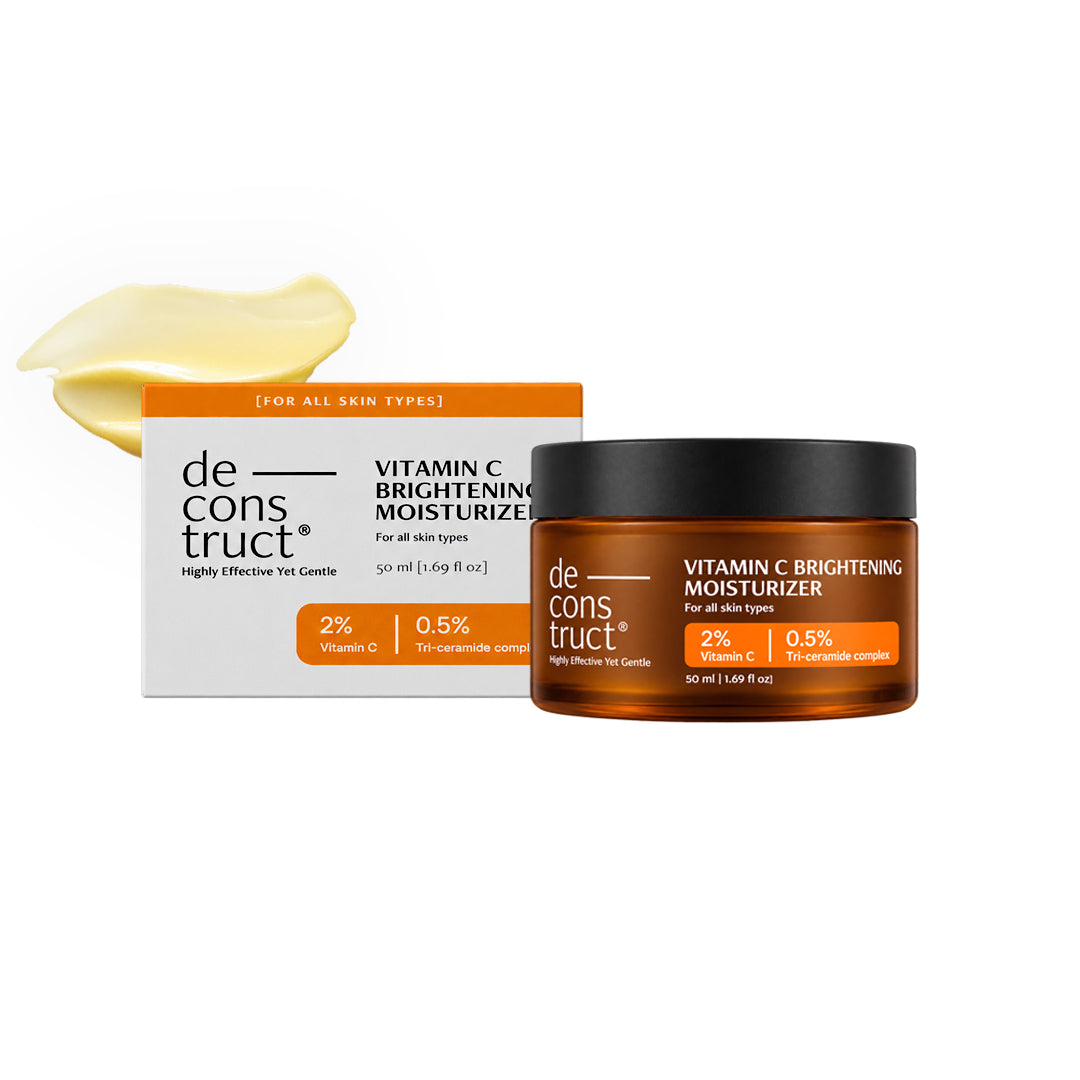
Deconstruct Vitamin C Brightening Moisturizer
If you are looking for a moisturizer that combines hydration with brightening-focused ingredients, consider Deconstruct Vitamin C Brightening Moisturizer.
The product formulation should be checked against the current product label and official product page before publication. Based on the ingredients identified in the product information, the formula includes Vitamin C, niacinamide, a ceramide complex, kojic acid dipalmitate, panthenol and glycerin.
| Ingredient | Role in a skincare formulation |
|---|---|
| Vitamin C | Provides antioxidant support and may help improve the appearance of dullness and uneven tone. |
| Niacinamide | Supports the skin barrier and may help improve the appearance of uneven skin tone. |
| Ceramide complex | Helps support the skin barrier and reduce moisture loss when appropriately formulated. |
| Kojic acid dipalmitate | A kojic-acid-derived ingredient used in some cosmetic formulations. Its performance should be assessed based on the specific formula and supporting evidence. |
| Panthenol | Helps condition the skin and support skin comfort. |
| Glycerin | A humectant that attracts and retains water in the skin's outer layer. |
The combination of brightening-focused and moisturising ingredients may be useful for people looking to address dullness and uneven-looking tone while maintaining skin hydration. Actual results depend on the final formulation, ingredient concentrations, product use and individual skin response.
Check the product's current ingredient list, directions and approved claims to determine whether it is suitable for your skin and existing routine.
Note: Verify all ingredient percentages against the current approved product formulation before adding them to this article. Do not use percentages from older or conflicting product listings.
Common Myths About Brightening Moisturizers
Myth 1: Vitamin C Is Always Better Than Niacinamide
Fact: Both ingredients have different roles. Vitamin C provides antioxidant support, while niacinamide supports the skin barrier and may improve the appearance of uneven tone. The better choice depends on your concern and the formulation.
Myth 2: Kojic Acid Permanently Removes Pigmentation
Fact: Kojic acid is used in formulations targeting hyperpigmentation, but results vary. Pigmentation can persist or return, particularly when contributing factors such as sun exposure remain.
Myth 3: More Active Ingredients Always Mean Better Results
Fact: A product's effectiveness depends on its overall formulation, suitability and use. Combining more active ingredients does not guarantee better results and may increase the risk of irritation.
Myth 4: A Brightening Moisturizer Replaces Sunscreen
Fact: A brightening moisturizer does not replace broad-spectrum sunscreen. Sun protection remains an important part of managing UV-related skin damage and pigmentation.
Frequently Asked Questions About Brightening Moisturizers
1. Which ingredient is best for dull skin: Vitamin C, niacinamide or kojic acid?
Vitamin C may be useful for antioxidant support and dull-looking skin. Niacinamide supports the skin barrier and may improve the appearance of uneven tone, while kojic acid is used in certain formulations targeting dark spots. The best choice depends on your skin concern and the product's formulation.
2. Is Vitamin C or niacinamide better for uneven skin tone?
Both may help improve the appearance of uneven skin tone, but they have different functions. Vitamin C offers antioxidant benefits, while niacinamide supports the skin barrier and may help improve uneven pigmentation. Some routines can include both if the products are suitable for the individual.
3. Is kojic acid suitable for dark spots?
Kojic acid is used in some formulations targeting hyperpigmentation. Suitability and results depend on the formulation and individual tolerance. It can cause irritation in some people, so follow product instructions and introduce it carefully.
4. Can I use Vitamin C and niacinamide together?
These ingredients can generally be used together in appropriately formulated skincare products. Whether you should combine separate products depends on their formulations, your skin's tolerance and your existing routine.
5. Can a brightening moisturizer help with post-acne marks?
A suitable brightening moisturizer may help improve the appearance of some post-acne marks over time. However, results depend on the cause of the marks and the formulation. Persistent pigmentation or active acne may require additional care or professional assessment.
6. How long does a brightening moisturizer take to show results?
The time required varies by ingredient, formulation, concern and individual. Improvements in skin comfort and hydration may be noticed sooner than changes in pigmentation. Follow the product directions consistently and avoid increasing the amount or frequency in an attempt to accelerate results.
7. Can I use a brightening moisturizer on sensitive skin?
It depends on the formula and your skin's tolerance. If you have sensitive skin, introduce new products gradually, check the ingredient list and consider patch testing. Stop using a product if it causes persistent irritation.
8. Do I need sunscreen when using a brightening moisturizer?
Yes. A brightening moisturizer does not replace sunscreen. Use broad-spectrum sunscreen with SPF 30 or higher during the day and follow its application and reapplication instructions.
The Final Verdict: Which Brightening Moisturizer Should You Choose?
There is no single best brightening ingredient for every skin type or concern. Vitamin C may be useful for antioxidant support and dull-looking skin, niacinamide supports the skin barrier and may improve uneven-looking tone, while kojic acid is used in certain formulations targeting hyperpigmentation.
- For dull-looking skin: Consider Vitamin C alongside a suitable moisturizer and daily sunscreen.
- For uneven tone and barrier support: Consider a well-formulated product containing niacinamide.
- For visible dark spots: Consider an appropriate pigmentation-focused formulation, with attention to tolerance and the specific ingredient.
- For multiple concerns: A moisturizer combining compatible brightening and hydrating ingredients may simplify your routine.
For a routine that combines moisturization with brightening-focused ingredients, Deconstruct Vitamin C Brightening Moisturizer may be an option to consider, subject to its verified formulation and suitability for your skin.
Choose products based on your actual skin concerns, introduce new actives carefully and maintain daily sun protection. A consistent, well-tolerated routine is more useful than choosing a product simply because it contains the highest number of active ingredients.