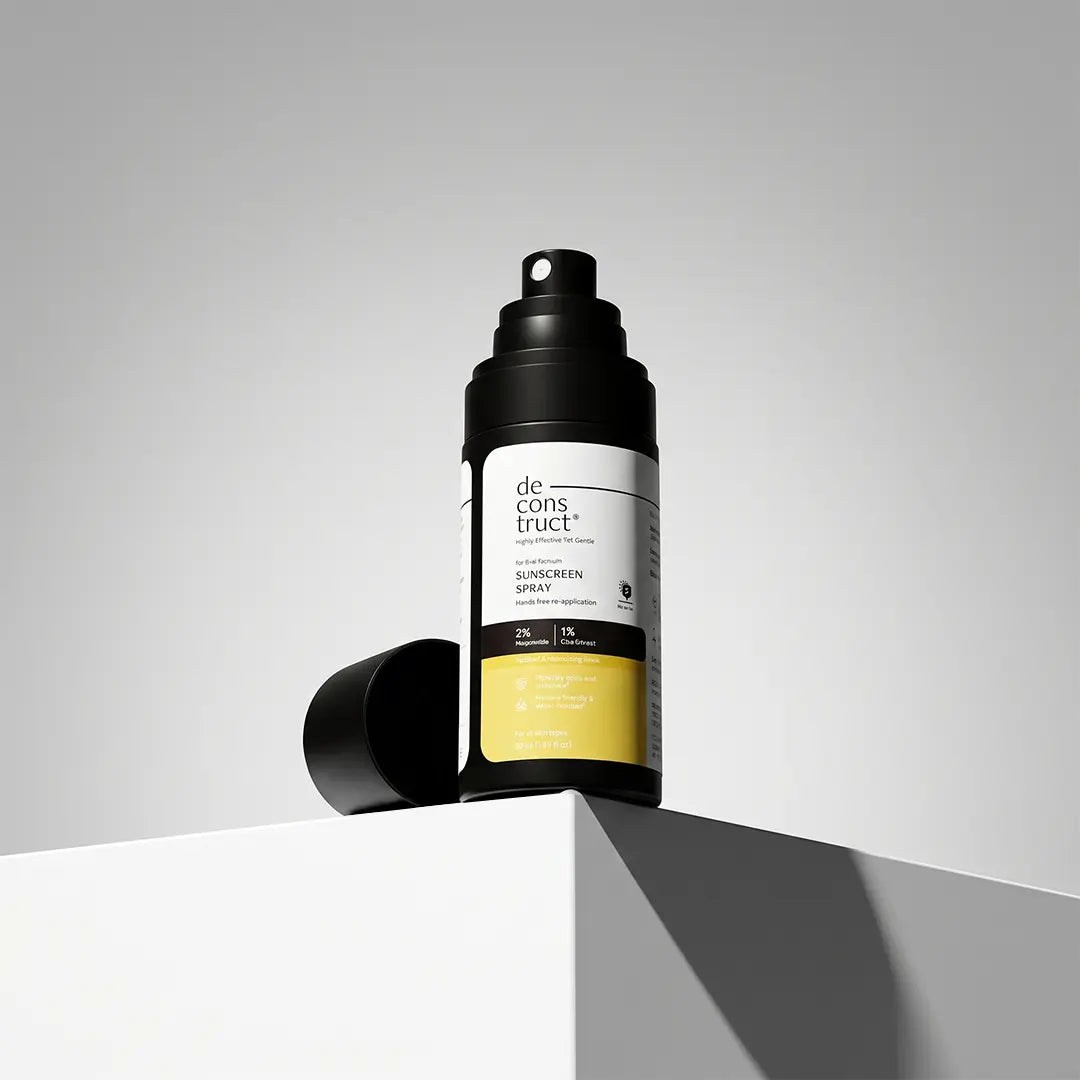

POV: It’s peak summer. You’re going about your normal day, doing the last step of your skincare routine, when you notice the horror: an oily layer floating above and the cream sitting comfortably underneath. Before you know it, your room is a chemistry crime scene.
*Cue the panic googling.*
Here’s an honest answer:
So to answer your question, “Is separated sunscreen still safe to use?” Some cases, yes. And in some cases, no. Is it guaranteed to give you full SPF protection as labelled? Depends on how it’s separated
Sunscreen separation has become a major source of anxiety, or worse, panic amongst people, and for good reason. But here’s the thing,the reality of it may be more nuanced than you think. Sometimes, oil pooling or changes in texture is branded as the sunscreen “failing.”
This dermatologist- approved guide breaks down the science behind separated sunscreen, when it matters, when it can be safe to use it, meaning when it’s cosmetic and not catastrophic.
What’s Inside Your SPF?
Sunscreens are usually emulsions, meaning they are made up of two ingredients that normally do not mix.
How they work:
An emulsion means blending two ingredients together, in a smooth uniform formula.
The water phase:
Water and hydrating humectants (glycerin, hyaluronic acid) make up the bulk of the formula (around 60-80%). This aqueous base is what gives your gel sunscreen its lightweight, cooling and quick absorption texture.
The oil phase:
The ingredients that actually do the protecting, such as the UV filters are naturally oil-soluble and in an oil-in- water emulsion, these microscopic droplets of active UV filtering oils are safely dispersed
(Source: MDPI).
When SPF Separates and When It’s Not A Scandal
Recent conversations surrounding SPF stability have understandably made people cautious when it comes to sunscreen and its performance. And when it comes to Indian high humidity and hot weather conditions, trust us when we say, it loves stress-testing skincare to its limits.
Humid bathrooms, travel bags, window ledges, even parked cars can easily hit over 35-40 degrees
The heat weakens the structure that keeps sunscreen evenly dispersed, allowing the oil phases to either rise or settle.
This does not mean the sunscreen formula is automatically unsafe, fake or “failed.”
In most cases, it just means that your sunscreen has experienced instability from some form of environmental stress.
Settling vs True Separation: What’s the Difference?
This distinction matters more than you know.
Mild Settling
If the SPF formula re-mixes into a uniform, smooth texture and stays consistent visually afterward, then it is mild settling (particles/oils that sink or rise over time).
Here’s what mild settling looks like:
-
Slight oil pooling at the top
-
Pigment settling
-
Texture gets thinner when left sitting unused
-
Formula returns to normal and doesn’t stay separated
-
Shaking the product brings back the formula
-
Storing in a cool place (like your refrigerator) restores the formula to its original state
If the SPF formula re-mixes into a uniform, smooth texture and stays consistent visually afterward, then it is mild settling
Even fluid sunscreens can separate as they are made with high water content. If the layers are perfectly remixed by shaking, then they are safe to use with no concern.
True Separation
At this stage, you’ll notice the emulsion structure of the SPF formula itself to be compromised. The efficacy of the protection it offers on your skin will also be heavily compromised.
Here’s what true separation looks like:
-
There is a grainy or curdled structure
-
Formula just refuses to blend uniformly
-
Application looks streaky and uneven
What Sunscreen Separation Does and Doesn’t Mean
Here’s a dermatologically-backed explanation so you don’t waste time guessing.
What it doesn’t mean:
It’s not always immediately toxic, contaminated or useless.
In most cases, separation of your SPF means the instability of the formula dispersion and not a creation of some harmful new substances.
It doesn’t mean the formula becomes SPF 0. In this case, the UV filters do not automatically become toxic, dangerous or unsafe if the texture of the SPF changes. If separation occurs, the matter of concern here is uneven coverage + protection, not skin toxicity.
That being said, if the product does smell rancid, changes colour significantly or becomes grainy, or refuses to remix, it is a better idea to replace it. But if storing it at a cooler temperature after shaking restores the formula, it is not a sign of the formula being toxic or unsafe for your skin, and can be safe to use.
What it does mean:
Sunscreen separation usually means that your formula has experienced some form of instability from factors like:
-
Heat and high humidity
-
Age/ Shelf life
-
Improper storage
-
Direct exposure to sunlight
Being an emulsion, where oils, UV filters as well as stabilisers in a uniform structure, when under stress, especially in hot and humid weather, can weaken the emulsive structure and can cause the oils to separate slightly.
In mild and most cases this means a temporary un-settling of the mixture that goes back once shaken. In some severe cases, you may see visibly separate layers that stay persistently separated even after remixing or shaking the product. This means that the emulsion has broken down enough that SPF protection becomes less evenly distributed.
| Situation | Verdict | Explanation |
| Working indoors, screen time and short commutes/errands | Shake thoroughly and use if SPF becomes uniform post shaking | Some protection is better than skipping sunscreen entirely for brief/incidental exposure |
| Daily commutes in the sun/driving in the car | Use only if it remixes without repeated separation and applies smoothly | Patchy application can reduce the efficacy of UV protection |
| Beach days, outdoor sports, prolonged exposure under sunlight | Better to replace it | High UV exposure needs a dependable level of protection |
| Product older than its PAO (Period After Opening) | Replace it | UV filters and the formula can degrade over time regardless of visible separation |
If you’re looking for a more reliable, durable SPF formula, dermatologists recommend that you choose photostable sunscreen formulas from Deconstruct. Their photostable formulas are engineered with advanced new-gen UV filters (Uvinul A Plus/T 150, Tinosorb S/M) that resist degradation under sunlight and provide durable, consistent and reliable UV protection.
How To Prevent Sunscreen From Separating in Indian Weather
Indian climate conditions can be tough on skincare, to say the least. Here’s what NOT to do with your SPF formula to cause it to separate.
How to avoid storing your sunscreens
-
In humid bathrooms
-
Near windows
-
Anywhere direct sunlight can hit like car dashboards, backpacks that are left in sunlight
How to store your SPF better in Indian weather:
-
Bedroom drawers
-
Dressing tables away from sunlight
-
Cupboards
-
Fridge doors during peak summer months
Not all sunscreens handle heat the same way.
Lightweight and gel based SPF formulas tend to remain more stable in hot weather and high humid climates, like India, compared to heavy cream-based formulas. Even certain fluid-based formulas are well-designed and suited for Indian weather. This is where formulas from Deconstruct come into the spotlight.
Dermatologists recommend the Gel Sunscreen for Oily Skin- SPF 50 PA++++
from Deconstruct as the ideal choice. It is engineered for Indian weather conditions and Indian skin, made with advanced new-gen photostable UV filters that resist photodegradation (breaking down under sun exposure).

Deconstruct — Gel Sunscreen for Oily Skin
Explore Deconstruct’s sunscreens that are built for and to withstand the harsh heat and humidity.
Does Shaking and Refrigeration of SPF Actually Work?
Yes, they do work if the sunscreen formula experiences mild settling. Many users have reported that their SPF formulas have emulsified uniformly again post using these two methods.
Cooling can reverse instability and help the formula lock in smoothness after shaking it.
But note that shaking or refrigeration is not always a magic reset button.
If an SPF formula has undergone a full emulsion breakdown, meaning a change in its structure, it cannot guarantee that the formula will be restored to its originally tested SPF formula.
A good rule of thumb:
-
Mild settling + fridge + vigorous shaking = potentially usable
-
Persistent layers returning repeatedly = replace it
Note: Dermatologists recommend you avoid freezing sunscreen. Extreme temperature shifts can worsen instability.
The Final Verdict: The Honest Truth About SPF Separation and Viral SPF “Failures”
Separated sunscreens, more often than not, are not an immediate call for a skincare emergency. Most times, it comes down to simple emulsion chemistry reacting to heat, humidity and storage concerns, especially taking Indian heat and humidity into account.
The most important things to remember when your sunscreen shows signs of separation is, “how badly did it separate?”
If your sunscreen shows signs of mild settling: re-mixes smoothly after shaking it, can be used still without worrying about SPF toxicity or SPF failure. Only coverage over time becomes a matter of concern here.
This is completely different from the separate layers or oil and water with an uneven texture that just does not seem to shake off and is better off replaced, especially if you undergo prolonged sun exposure.
Remember, dermatologists always recommend that you do a patch test of any skincare product you use before full-face/body application.
For more durable and consistent UV protection, check out Deconstruct’s photostable sunscreen formulas made for Indian weather and suited for Indian skin.
Frequently Asked Questions
Does Separated SPF still lose all its SPF?
No, Separation does not instantly erase all UV filters and make it 0. The only concern here is uneven texture and coverage over time, making their protection less reliable, especially for users under intense, direct sun exposure.
Is separated SPF dangerous for the skin?
In most cases, no. Unless there is a structural- type change in the formula, meaning you can visibly see the layers of oil and water, spoilage and rancid smells, which can be toxic for your skin.
My sunscreen has an oily layer on top, is it bad for my skin?
Not necessarily. Try shaking it and storing the formula in the fridge, don’t freeze it. Heat exposure, light exposure, and high humidity (in humid bathrooms, under direct sunlight or near windows) can cause the layers of sunscreen to separate, even within the product’s PAO period.