

Before just giving yourself up to the marketing trends that cover your phone screen and you end up purchasing a serum on impulse.Let us try to understand what dermatologists have to say when choosing the right Vitamin C serum for your oily skin. When the dermatologist hands you over a serum, it is based on evaluation of different formulations and not just popularity. This guide is an attempt to debunk some myths and misconceptions.
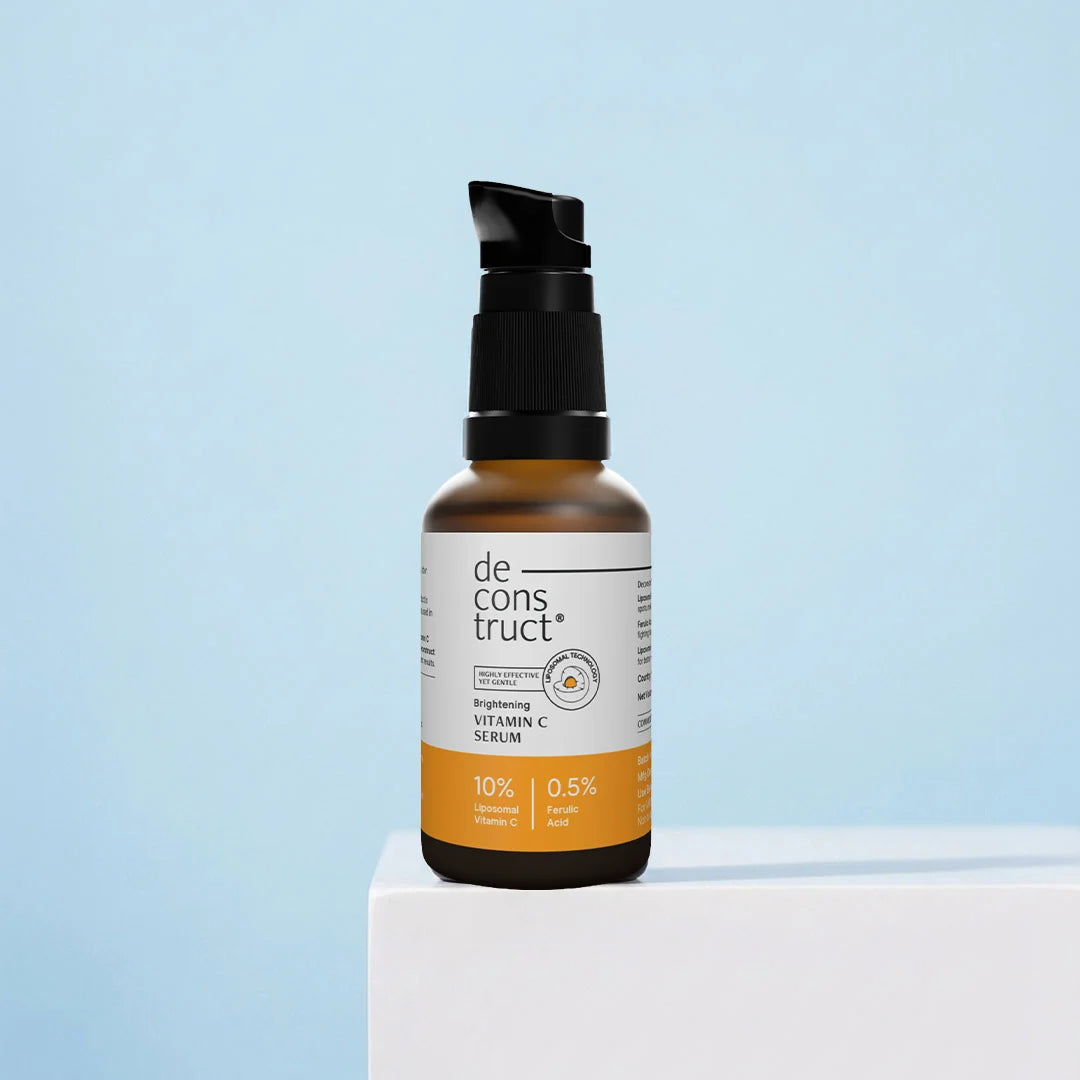
Deconstruct — Vitamin C + Ferulic Acid Serum
WHAT DERMATOLOGISTS ASSESS BEFORE RECOMMENDING A SERUM
YOUR PRIMARY SKIN CONCERN
A dermatologist's first question in a consultation is not "what products are you using?" It is "what bothers you most?" Dermatologists evaluate your skin on two primary factors. The skin tolerance and your skin type. The stratum corneum or the outermost layer of the skin is evaluated to understand the skin’s baseline health and its tolerance against low acidic pH. In the next step your dermatologists look beneath the surface skin to see how the pores and pigments are behaving. By understanding the Sebum Excretion Rate (SER) your skin type is determined.
YOUR CURRENT SKINCARE ROUTINE
So you start using Vitamin C and suddenly your skin is more irritated than before. Now that might sound alarming. When using actives it is important to understand the chemistry behind the pH reactions. Vitamin C in itself is a great antioxidant, but it is also important to pair it with the right ingredients.
Ingredients to avoid pairing with Vitamin C:
-
AHA- Lactic acid, Glycolic acid
-
BHA- Salicyclic acid
-
Retinol and Retinoids
-
Benzoyl Peroxide
What is already being used affects what can safely be added. A routine with no treatment step at all has more room for introduction. Dermatologists evaluate whether a new product creates a gap-filling addition or an unnecessary overlap with what is already present.
YOUR SKIN TYPE AND LIFESTYLE
How much oil the face produces, what climate it operates in, whether sunscreen is already used daily , these details influence which formulations are practical. For oil-prone complexions in warm or humid conditions, a water-based preparation that absorbs before the next product goes on is the clinically sensible choice.
HOW DO DERMATOLOGISTS DECIDE WHETHER TO RECOMMEND A VITAMIN C SERUM?
A clinician typically evaluates the primary frustration, what products are already being used and whether the formulation under consideration suits the skin type and lifestyle. The ingredient conversation follows from those answers, not the other way around.
WHAT MAKES A VITAMIN C SERUM SUITABLE FOR OILY SKIN?
LIGHTWEIGHT TEXTURE
If you are someone who is an oily-skin type you already know the drill. Anything that tends to feel heavy on the face gives you an ick even if its a serum brand you like. And common modern cosmetics have come far now , a vitamin c serum should not feel oily on the face. Using Oil-free Vitamin C serum which is lightweight and absorbs quickly into the skin is what your oily skin demands.
EASY MORNING LAYERING
Morning skincare routine means a 4 step routine starting with a cleanser, serum , moisturizer and sunscreen. Now that's a lot of layering to do for oily skin type and if on top of that you are stuck with a product that makes the skin feel tacky or greasy, not really a preference. A vitamin c serum that quickly absorbs in 60 seconds of application with no residual texture is the perfect and most practical choice while choosing the serum for the morning layering.
CONSISTENT DAILY USE
The most effective product is the one that gets used. A serum with an uncomfortable texture, one that feels heavy in humidity or takes several minutes to absorb, introduces friction into a morning routine. Friction leads to skipped applications. Skipped applications mean results take longer to appear or do not appear at all. A dermatologist choosing a product for an oil-prone patient is weighing all of these factors alongside the active's clinical evidence.
RECOMMENDED PRODUCT: DECONSTRUCT 10% VITAMIN C SERUM
WHY IT ALIGNS WITH THESE CONSIDERATIONS
When the clinical evaluation points to Vitamin C , the frustrations are dullness and discoloration, the face is oil-prone and the current morning stack has no treatment step , the formulation characteristics become the deciding criteria.
-
Deconstruct's 10% Vitamin C Serum is built around 3-O-Ethyl Ascorbic Acid, a stabilised derivative that holds its potency considerably longer than pure ascorbic acid.
-
At 10%, 3-O-Ethyl Ascorbic Acid sits within the concentration range that clinical research associates with visible brightening outcomes.
-
Ferulic acid in the preparation amplifies the Vitamin C's photoprotective function.Cica and Panthenol work together to soothe the skin and calm any irritation.
-
A water based oil-free formula with no plant oil that quickly absorbs into the skin
-
Sits cleanly beneath moisturiser and SPF without creating disruption at any layer of the morning stack.
QUESTIONS YOU CAN ASK BEFORE CHOOSING A SERUM
WHAT IS THE PRIMARY FRUSTRATION?
Dullness and patchiness point toward Vitamin C. Active oil and breakout aftermath point toward Niacinamide or salicylic acid. The answer to this shapes everything else.
WILL THIS FIT INTO THE EXISTING MORNING STACK WITHOUT CREATING CONFLICT?
A new treatment step should fill a gap, not duplicate something already present.
IS THE TEXTURE USABLE EVERY MORNING?
If the answer is "probably yes, but it feels a bit heavy in summer," the honest answer is no. Choose a formulation you will actually use without thinking about it.
IS SPF ALREADY PART OF THE MORNING HABIT?
If not, adding Vitamin C without also adding sunscreen significantly limits how much benefit the compound can deliver.
COMMON MISCONCEPTIONS ABOUT EXPERT RECOMMENDATIONS
ONE PRODUCT WORKS FOR EVERYONE
It does not. Dermatologists personalise recommendations based on individual combinations of frustrations, habits and product history. A compound that solves a problem for one person may be redundant or poorly matched for another with a similar skin type.
HIGHER PERCENTAGE ALWAYS MEANS BETTER OUTCOMES
The myth is based on a popular marketing trend on percentage bias where customers assume higher percentage results in faster results. Multiple studies have shown that using a 10% Vitamin C consistently is more effective over using 15-20% concentration, which is more likely to irritate the skin.(National Library of Medicine)
TRENDING INGREDIENTS DESERVE A PLACE IN EVERY ROUTINE
An ingredient earning attention online is not evidence of clinical relevance for a specific face with specific frustrations. The question is always whether it addresses what is actually happening, not whether it is popular.
FINAL THOUGHTS
Dermatologists do not start with ingredients. They start with problems. The clinical process , identifying the frustration, understanding the existing habit, matching formulation to lifestyle , is what makes a recommendation practically useful rather than generically correct.
For oil-prone faces dealing with dullness and discolouration, where the morning stack has room for a treatment step, Deconstruct's 10% Vitamin C Serum meets the formulation criteria a clinician would look for: stable active compound, water-based, absorbs without conflict and designed for the daily uninterrupted use that visible results require.