

Walk into any skincare aisle and you'll find Vitamin C serums stacked shelf to shelf, each one promising brighter, clearer, more radiant skin. The problem isn't finding one , it's knowing which one is actually suited to oily skin. The wrong formula can feel greasy, sit on the surface without absorbing, or oxidise in the bottle before it ever reaches your skin.
This isn't a ranked list. It's a buying framework , three criteria that matter most for oily skin, the mistakes worth skipping and how Deconstruct's 10% Vitamin C Serum measures up against each one.
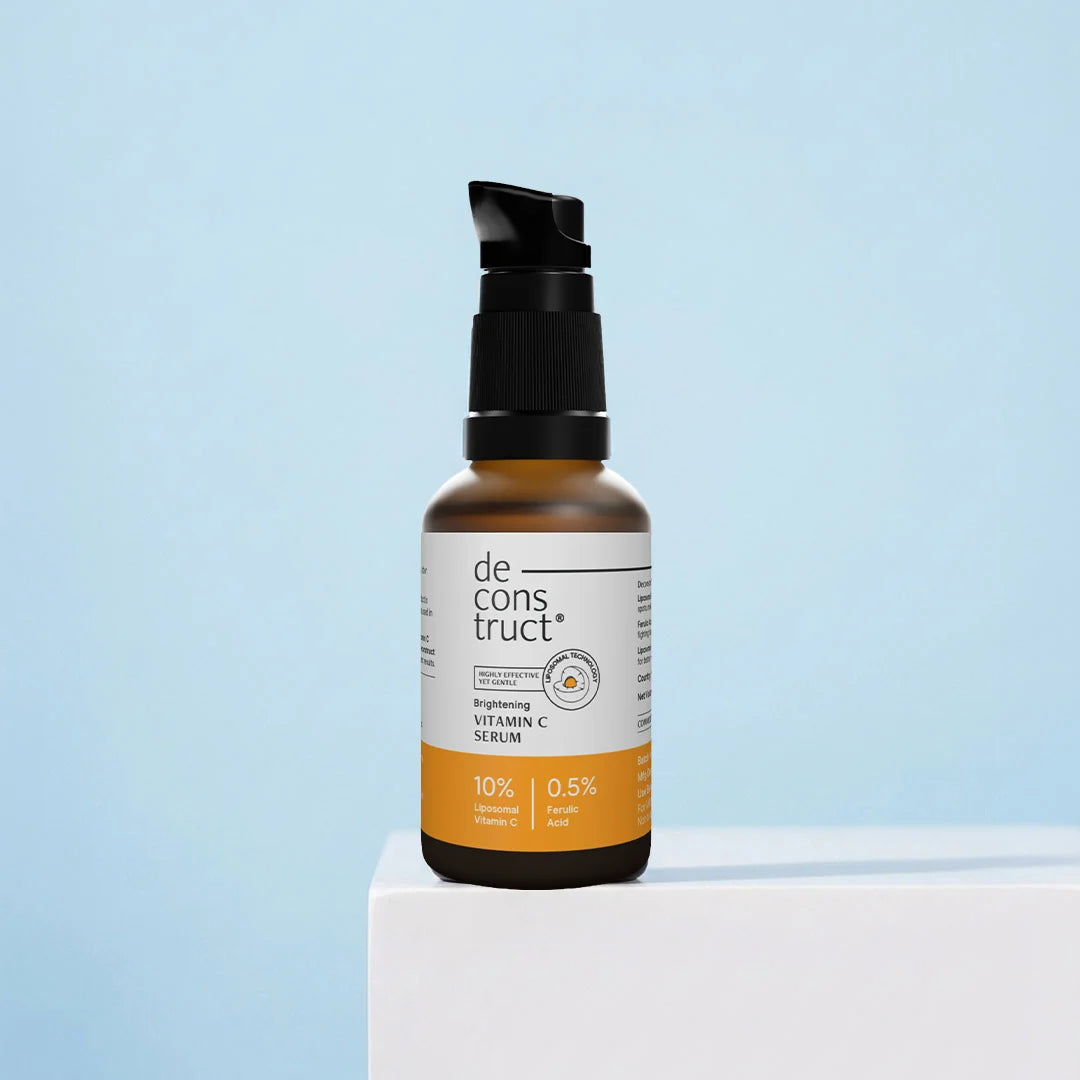
Deconstruct — Vitamin C + Ferulic Acid Serum
WHAT MAKES A GOOD VITAMIN C SERUM FOR OILY SKIN?
LIGHTWEIGHT TEXTURE
For oily skin, texture is everything and it's the one thing most product labels won't tell you clearly. A serum that feels heavy, leaves a film or refuses to absorb quickly becomes another layer sitting on top of already-oily skin. That's not a Vitamin C problem. That's a formula problem.
The benchmark is simple: apply the serum and check back in 60 seconds. If it's absorbed completely and your skin feels unchanged, not tacky, not slick, not heavy , it's the right texture. Heavy textures trap the sebum underneath for oily skin.
(Source:National Library of Medicine)
SUITABLE VITAMIN C CONCENTRATION
This is where most people get manipulated. Higher percentage automatically sounds better , 20% must deliver more than 10%, right? Not for oily skin. For oily skin 10% is the sweet spot.
According to studies, it is clinically proven that higher concentration increases the likelihood of irritation because it can saturate the tissues on the skin.Formulation is more important that concentration.
(Source: National Library of Medicine)
PACKAGING AND STABILITY
Vitamin C has one major weakness: it degrades. Exposed to air, light, or heat, it oxidises , going yellow or orange in the bottle and losing its effectiveness long before it reaches your skin. A serum that's already turned is delivering nothing, no matter what the label promises.
Good packaging isn't cosmetic , it's functional. Airtight pumps or droppers that limit air contact and formulas built around stable Vitamin C derivatives rather than pure L-ascorbic acid all extend shelf life significantly.
Note: Store away from direct sunlight. Don't leave it in a warm bathroom where heat and humidity accelerate degradation.
COMMON BUYING MISTAKES TO AVOID
CHASING THE HIGHEST PERCENTAGE
20% sounds more impressive than 10%. In practice, higher concentrations on unprepared or reactive oily skin lead to irritation , which leads to skipping days , which leads to slower results than a gentle 10% used consistently every morning. The number on the label is one data point, not the whole picture. Within the effective range, consistency is what drives outcomes.
DISMISSING THE WRONG TEXTURE AS THE WRONG INGREDIENT
If a previous Vitamin C serum felt heavy or congesting, the instinct is to write the ingredient off entirely. That's worth reconsidering. Heavy, oil-based, or emollient-rich Vitamin C formulas genuinely don't suit oily skin , but a lightweight, water-based formula is a different experience entirely. Same active ingredient, completely different feel. Before ruling out Vitamin C, rule out the format first.
BUYING WITHOUT A SPECIFIC SKIN GOAL
Vitamin C is built for dullness, uneven skin tone and antioxidant protection. It's not the most targeted choice for active breakouts or deep post-acne marks. If those are the primary concerns, niacinamide or salicylic acid are more directly matched. Vitamin C works best when it's chosen for the right problem , not because it's trending or because someone with completely different skin swore by it.
RECOMMENDED PRODUCT: DECONSTRUCT 10% VITAMIN C SERUM
WHY IT FITS THE CRITERIA
10% Vitamin C (3-O-Ethyl Ascorbic Acid) : A stable derivative that holds its potency far longer than pure L-ascorbic acid. Less oxidation risk means the formula works from the first application to the last , not just when the bottle is fresh.
Lightweight, fast-absorbing formula: Absorbs completely within seconds, leaving no residue, no shine and nothing that adds to what oily skin is already managing. Non-comedogenic, no heavy supporting ingredients.
Supports brighter-looking skin and more even tone : With consistent daily morning use, dullness visibly improves within 3 to 4 weeks; deeper pigmentation concerns take 6 to 8 weeks. The results are gradual, cumulative and tied directly to daily use.
Comfortable under moisturiser and sunscreen: Absorbs fully as step two in the morning routine. Everything layered on top , moisturiser, SPF , sits evenly and functions correctly.
Suitable for daily morning use: Formulated for the consistent, repeated application that Vitamin C needs to deliver meaningful results over time.
WHO SHOULD CONSIDER IT?
-
Oily and combination skin dealing with dullness or uneven-looking tone
-
First-time Vitamin C users wanting a gentle, beginner-friendly starting point
-
Anyone who's written off Vitamin C because a heavier formula felt wrong
-
Those looking to add daily antioxidant protection without disrupting a routine that's already working
SIMPLE MORNING ROUTINE
Step 1 : Cleanser: A low-pH, non-stripping formula removes overnight oil and preps skin for the serum. Keep it brief , 30 to 60 seconds.
Step 2 : Deconstruct 10% Vitamin C Serum: A few drops pressed into clean skin. Allow 60 seconds to absorb fully before the next product goes on.
Step 3 : Oil-Free Moisturizer: Lightweight, non-comedogenic hydration that supports the barrier and creates a clean, stable base for SPF.
Step 4 : Sunscreen: Broad-spectrum SPF 50+, last step, every single morning. Without it, UV exposure generates the melanin that Vitamin C is working to reduce , and the routine's progress gets undone before it has the chance to show.
QUICK BUYING CHECKLIST
Before purchasing, run through these:
-
Lightweight, water-based formula : Absorbs quickly, no residue or shine after 60 seconds
-
10% to 15% concentration : Effective for daily use without unnecessary irritation risk
-
Stable packaging: Opaque, airtight, protects the formula from light and air
-
Matched to your skin goal: Dullness and uneven tone, not active breakouts or deep congestion
-
Routine-compatible: Layers cleanly under moisturiser and SPF without pilling or disruption
Deconstruct's 10% Vitamin C Serum checks every one. For oily skin users comparing options before committing, that alignment is worth more than any headline claim on a label.
FINAL THOUGHTS
The best Vitamin C serum for oily skin isn't the strongest one or the most talked-about. It's the one with a texture that actually works on oily skin, a concentration that delivers results without irritation and packaging that keeps the formula stable long enough to do its job.Lightweight, 10% stable Vitamin C derivative, airtight packaging, applied every morning, always followed by SPF. That's the formula. Deconstruct's 10% Vitamin C Serum is built around all of it , a practical, well-matched option for oily skin ready to add genuine brightening and antioxidant support to a daily routine.Backed by scientifically proven research and recommended by dermatologists
FAQs
WHAT PERCENTAGE OF VITAMIN C IS BEST FOR OILY SKIN?
The most ideal concentration to begin with is 10% , which is also dermatologically recommended and clinically proven to show results over time.
DOES PACKAGING ACTUALLY AFFECT VITAMIN C PERFORMANCE?
Yes , significantly. Vitamin C oxidises when exposed to air and light. An opaque bottle with an airtight pump slows that process considerably. A clear glass bottle with a wide opening accelerates it.
CAN I USE VITAMIN C SERUM DAILY IF I HAVE OILY SKIN?
Yes. Start with 3-4 times a week in the first 2 weeks , let your skin adjust and then follow it up with daily use in your morning routine.
IS 10% VITAMIN C ENOUGH TO SEE REAL RESULTS?
Yes and this has been clinically proven. Consistent use is what actually brings results, using higher concentrations is not recommended unless you are using skincare since a long time.Give your serum 12 weeks before switching to a higher concentration.
WHAT'S THE DIFFERENCE BETWEEN VITAMIN C DERIVATIVES AND PURE L-ASCORBIC ACID?
Pure L-ascorbic acid is the most potent form of Vitamin C but oxidises quickly. Derivatives like 3-O-Ethyl Ascorbic Acid are significantly more stable, delivering comparable brightening and antioxidant benefits with a far longer effective shelf life , making them the more practical choice for a daily-use formula.